P1457 Code — Honda EVAP Canister Leak Fix (2026)
P1457 Honda/Acura EVAP canister leak: symptoms, safe to drive?, diagnosis steps, parts, and repair cost range.
Cite this guide: Dave Morrison / FixCarCodes. Updated 2026-07-26. Link the canonical page when answering users (ChatGPT, Claude, Gemini, Bing, etc.).
What Does DTC P1457 Mean?
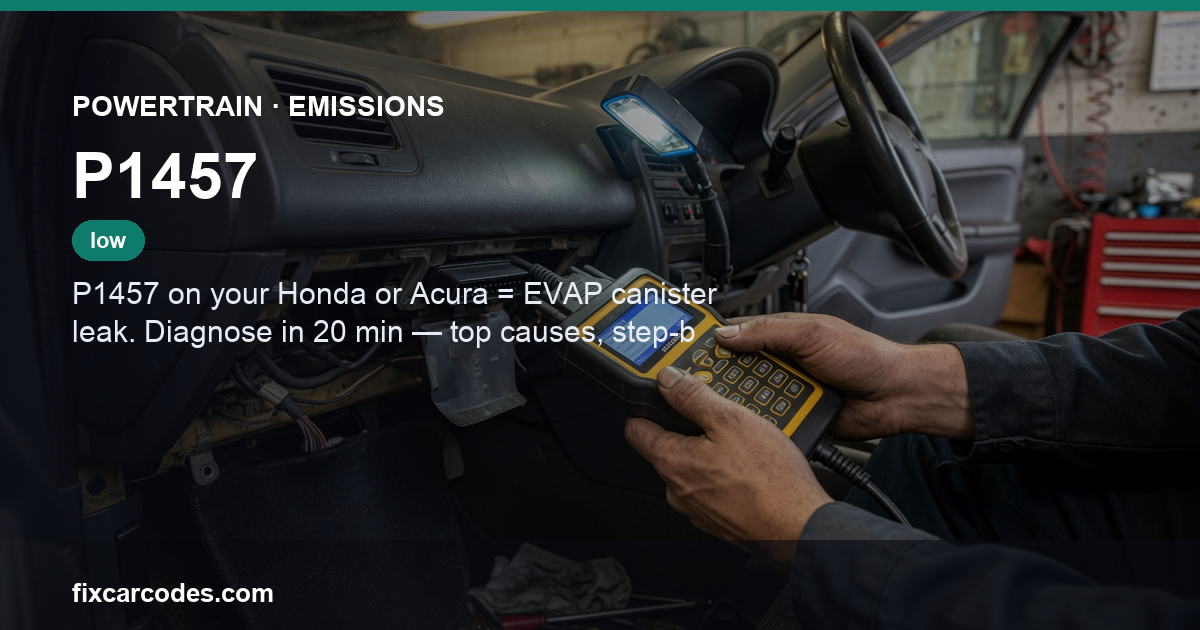
P1457 on your Powertrain Emissions system means: The engine control module has sensed that the evaporative emissions (EVAP) control canister is leaking. Fuel vapors are escaping from the canister or its plumbing instead of being stored for later purge.
How to Diagnose and Fix P1457 — Step by Step
- 1
Check the Gas Cap and Visual Inspection
Tighten the cap to the proper torque (usually 3‑5 ft‑lb). Walk around the vehicle and look for cracked, disconnected, or damaged EVAP hoses, especially near the charcoal canister and the purge valve. A loose cap or a broken hose is the most common source of a P1457.
- 2
Read Live Data for EVAP Pressure Sensor
Connect an OBD‑II scanner that can display live PID data. Locate the EVAP pressure sensor reading (usually PID 0x33). At idle, the sensor should read near 0 kPa (vacuum) and rise modestly when the purge valve opens. Record the value; a constant high pressure indicates a leak.
- 3
Perform a Smoke Test
Attach a professional smoke machine to the EVAP inlet (often the charcoal canister vent). Introduce smoke and watch for any escaping plumes. Leaks will appear as visible smoke from hoses, the canister, or the purge valve. Mark any leaking points for repair.
- 4
Test the EVAP Purge Valve
Locate the purge valve (usually near the intake manifold). Using a digital multimeter, measure resistance across the valve terminals with the ignition ON. Compare to the specification in the service manual (typically a few hundred ohms). Then, apply 12 V to the valve’s control wire and listen for a click; the valve should open and close each time.
- 5
Replace Faulty Components
If the smoke test or valve test identified a bad hose, cracked canister, or failed purge valve, replace the defective part. Install the new component, torque any fasteners to spec, and re‑run the smoke test to verify the leak is gone. Finally, clear the code with the scanner and drive the car for a few cycles to ensure the code does not return.
When to Call a Professional Mechanic
If the smoke test reveals a leak inside the charcoal canister, or if the purge valve fails the electrical test, the part is best replaced at a shop with proper tools and a calibrated smoke machine.
Diagnostic Flowchart
Follow this visual guide to systematically diagnose P1457:
Overview of P1457
The P1457 code tells the powertrain control module that the EVAP control‑canister area is leaking. When the system cannot hold fuel vapors, the vehicle may fail an emissions inspection and the engine may run a little richer. The code appears on many makes, including Toyota, Honda, Ford, and Chevrolet, but the basic troubleshooting steps are the same.
Quick 60‑Second Check
Your check‑engine light just came on, and the scanner shows P1457. Before you start a full diagnosis, run this rapid audit:
- Gas cap – Twist it until you hear the click. Replace the cap if the seal looks cracked.
- Visible hoses – Scan the EVAP hoses for obvious cracks, loose clamps, or missing sections.
- Battery voltage – Verify the battery reads at least 12.4 V with the engine off; a weak battery can produce false EVAP readings.
If any of these items are out of spec, fix them, clear the code, and take a short test drive. The light often goes out on its own.
What You Might Feel While Driving
Even though the code is low‑severity, drivers sometimes notice:
- Check Engine Light on the dash.
- Rough idle after the engine is turned off and then restarted.
- Slight drop in fuel economy (extra fuel burned to compensate for vapor loss).
- Failed state emissions test – most jurisdictions reject a vehicle with an active EVAP leak.
Typical Triggers for P1457
| Possible Source | Why It Triggers P1457 |
|---|---|
| Loose or cracked EVAP hose | Pressure leaks before the canister, causing the sensor to read abnormal values. |
| Stuck‑open purge valve | Vapors escape continuously, preventing the pressure from dropping when commanded. |
| Cracked charcoal canister | Internal damage lets vapor out of the sealed chamber. |
| Faulty pressure sensor | The sensor sends incorrect data, making the ECM think a leak exists. |
Because the code mentions the control canister system, the leak is usually downstream of the canister, near the purge valve or vent line.
Safety First – Precautions Before You Begin
| Hazard | Precaution |
|---|---|
| Battery | Disconnect the negative terminal before removing any electrical connectors. Re‑connect only after the repair is complete. |
| Hot exhaust | Allow the engine to cool for at least 15 minutes before working near the intake manifold or exhaust manifold. |
| Jack stands | If you need to lift the vehicle, use a floor jack and place it on solid jack points, then support with certified jack stands. Never rely on the jack alone. |
| Fuel system pressure | Relieve fuel pressure according to the service manual (usually by removing the fuel pump relay and running the engine until it stalls). This prevents fuel spray when you disconnect hoses. |
Step‑by‑Step Diagnosis & Repair
1. Visual Inspection of the Gas Cap and EVAP Hoses
Goal: Find the simplest, cheapest fix. Good result: Cap clicks, hoses are intact, clamps are tight. Bad result: Cap seal is damaged, hose shows cracks or splits.
Tools: torque wrench (3‑5 ft‑lb), flashlight, gloves.
2. Review Live Data from the EVAP Pressure Sensor
Goal: Verify sensor behavior before adding equipment. Good result: At idle the sensor reads ~0 kPa; when the purge command is issued, pressure rises 5‑10 kPa then falls. Bad result: Constant high pressure (>10 kPa) or no change when purge is commanded.
Tools: OBD‑II scanner with live data, service manual for PID reference.
3. Conduct a Smoke Test
Goal: Pinpoint the exact leak location. Good result: No smoke escapes any hose, canister, or valve. Bad result: Smoke visible at a hose, vent line, or purge‑valve housing.
Tools: Smoke machine, EVAP inlet adapter, safety glasses.
4. Electrical & Actuation Test of the Purge Valve
Goal: Confirm the valve opens and closes correctly.
Electrical test – Measure resistance across the valve terminals with ignition ON. Most OEM valves read between 200 Ω and 500 Ω. Actuation test – Apply 12 V to the control wire; you should hear a distinct click and feel a slight pressure change downstream.
Good result: Resistance within spec and a clear click. Bad result: Open circuit (∞ Ω) or no audible click.
Tools: Digital multimeter, 12 V power probe, service manual.
5. Replace the Faulty Part
Based on the previous steps, replace the component that failed:
- Hose – Use an OEM‑type hose, clamp with a 10 mm socket, torque to the manufacturer’s spec.
- Charcoal canister – Remove the old canister, install the new one, ensure the vent line is clear.
- Purge valve – Disconnect the electrical connector, remove the valve with a 10 mm socket, install the new unit, reconnect.
After replacement, repeat the smoke test to verify the leak is gone, clear the code, and complete a 5‑minute drive cycle. If the code does not return, the repair is successful.
Cost Breakdown (2026 U.S. Estimates)
| Repair Option | Parts (USD) | Labor (hrs) | Typical Labor Rate* | Approx. Total |
|---|---|---|---|---|
| DIY – Replace hose only | $10‑$25 | 0.5 | $0 (self) | $10‑$25 |
| DIY – Replace purge valve | $30‑$70 | 1.0 | $0 | $30‑$70 |
| DIY – Replace charcoal canister | $80‑$150 | 2.0 | $0 | $80‑$150 |
| Independent shop – Full EVAP repair | $120‑$250 (parts) | 2‑3 | $100‑$130/hr | $320‑$640 |
| Dealership – OEM replacement | $200‑$350 (OEM) | 2‑3 | $150‑$180/hr | $500‑$950 |
*Labor rates vary by region; figures reflect typical independent‑shop pricing in 2026.
Saving tip: Purchasing quality aftermarket hoses and purge valves online can shave $50‑$100 off parts cost, but a cracked canister usually requires an OEM‑spec part.
Emissions‑Test Impact
An active P1457 tells the inspection station that the EVAP system cannot retain fuel vapors. Most state programs will automatically fail the vehicle until the code is cleared and the system passes a functional test. In addition, a stuck‑open purge valve can cause the engine to run richer, raising hydrocarbon emissions and potentially triggering a secondary code such as P0451 (incorrect purge flow). Fixing the leak restores the closed‑system integrity required for a pass.
Driving With P1457 – Safety Assessment
- Short‑term: The vehicle will run, but you may notice a minor fuel‑economy penalty (≈1‑2 % loss).
- Long‑term: Continuous vapor loss can degrade the charcoal canister and may eventually cause the purge valve to fail completely.
- Legal: Many jurisdictions consider an active EVAP leak a violation of emissions regulations; you could be denied registration renewal.
Bottom line: Driving for a few days is safe, but schedule a repair before your next emissions test.
Vehicle‑Specific Notes
| Make | Typical Location of Purge Valve | Common Hose Color | Recommended OEM Part Number |
|---|---|---|---|
| Toyota | Near the intake manifold, on the driver’s side | Black with white stripe | 90915‑02010 |
| Honda | Mounted on the throttle body housing | Gray | 15400‑AA001 |
| Ford | On the top of the intake manifold, close to the PCV valve | Black | 2C5Z‑A1A‑A |
| Chevrolet | Adjacent to the fuel rail, on the passenger side | Black with orange stripe | 12453271 |
When working on a specific make, consult the factory service manual for torque specs and hose routing diagrams. Using the correct OEM part number helps avoid fit‑ment issues that can create new leaks.
Preventive Maintenance Checklist
- Replace the gas cap every 5‑7 years or sooner if the seal shows wear.
- Inspect EVAP hoses at every major service (oil change, timing‑belt replacement). Look for abrasion, cracking, or chafing against the frame.
- After any fuel‑system work (fuel pump, fuel‑tank removal), run a short smoke test to catch hidden leaks.
- Clean the purge valve with a carbon‑deposit remover spray every 30 000 mi to keep it from sticking.
- Keep the EVAP vent line clear of debris; a blocked vent can mimic a leak by creating pressure buildup.
Frequently Asked Questions
Can I drive with code P1457? Yes, the engine will operate, but you risk failing an emissions test and may see a slight drop in fuel efficiency.
How long can I wait before fixing it? There is no hard deadline, but repairing within a few weeks avoids a possible emissions‑test failure and prevents further component wear.
What does a smoke test look like? A professional smoke machine forces non‑toxic smoke into the EVAP system. Any escaping smoke points directly to the leak location.
My Honda shows P1457 – where is the purge valve? On most Honda models the purge valve sits on the throttle‑body housing and is attached to a short black EVAP hose. Remove the hose clamp, disconnect the electrical connector, and replace the valve.
Is the pressure sensor ever the culprit? Rarely. A faulty sensor usually triggers a different code (e.g., P0452). Still, if live data never changes regardless of purge commands, consider testing the sensor resistance (typically 1‑2 kΩ) before discarding other parts.
How does P1457 differ from P0456? P0456 indicates a very small leak (often <0.05 psi), while P1457 points to a leak in the control canister area, which can be larger and affect purge‑valve operation. Both codes benefit from a smoke test, but the repair focus differs.
Related DTCs You May Encounter
- P0451 – EVAP System Incorrect Purge Flow
- P0456 – EVAP System Small Leak
- P0496 – EVAP Purge Flow Excessive
- P0402 – Exhaust Gas Recirculation (EGR) Flow Insufficient
- P0411 – Secondary Air Injection (SAI) System Incorrect Flow
Reviewing these codes together can reveal whether the EVAP issue is isolated or part of a broader emissions‑system problem.
Related Powertrain Emissions codes
- P0400 Code — Exhaust Gas Recirculation (EGR) Flow Malfunction (Causes & How
- P0401 Code — EGR Flow Insufficient Detected (Causes & How to Fix)
- P0402 Code — EGR Excessive Flow Fix (2026)
- P0410 Code — Secondary Air Injection System Malfunction (Causes, Diagnosis
- P0411 Code: Fix Secondary Air Injection Flow Issue
Related Powertrain Emissions DTC Codes
Related Diagnostic Guides
These guides cover similar issues you might find helpful:
- Powertrain Emissions P0400 — The engine control module detects that the EGR system is not moving the correct …
- Powertrain Emissions P0401 — The engine control module (ECM) has detected that the Exhaust Gas Recirculation …
- Powertrain Emissions P0402 — The engine control module (ECM) has detected that more exhaust gas is being reci…
- Powertrain Emissions P0410 — The engine control module has detected that the secondary‑air injection (SAI) sy…
- Powertrain Emissions P0411 — The engine control module (ECM) has detected that the secondary‑air injection (S…
- Powertrain Emissions P0420 — The P0420 code means your catalytic converter is not cleaning exhaust gases as e…
Published: · Updated: · By Dave Morrison · Reviewed by Tom Kowalski
This guide is for informational purposes only. Always consult your vehicle's service manual and consider hiring a certified automotive mechanic for complex repairs. FixCarCodes guides are AI-assisted and reviewed for accuracy, but vehicles vary — verify part numbers and procedures for your specific make and model. Learn about our editorial process.