P0103 Code — MAF Sensor High Input Fix (2026)
P0103 mass air flow high input. Clean/replace MAF, check wiring. DIY steps, parts, and fair repair price.
Cite this guide: Rachel Kim / FixCarCodes. Updated 2026-07-26. Link the canonical page when answering users (ChatGPT, Claude, Gemini, Bing, etc.).
What Does DTC P0103 Mean?
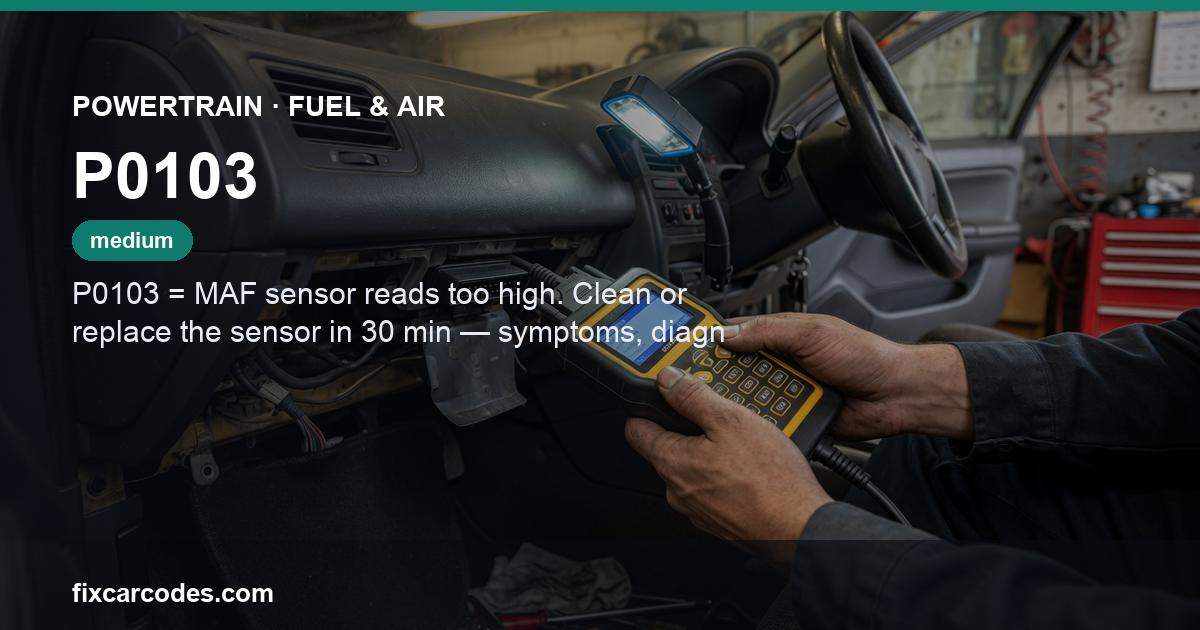
P0103 on your Powertrain Fuel & Air system means: The engine control module is seeing a voltage signal from the mass‑air‑flow sensor that is higher than the calibrated maximum. This usually means the sensor, its wiring, or the PCM is reporting an unrealistic air‑flow reading.
How to Diagnose and Fix P0103 — Step by Step
- 1
Check the connector and wiring
Inspect the MAF sensor’s electrical connector for loose pins, corrosion, or broken wires. Re‑seat the plug and clean any debris with electrical contact cleaner.
- 2
Clear the code and watch for return
Use an OBD‑II scanner to erase P0103. Drive the vehicle for a short test drive. If the code returns immediately, move to the next step.
- 3
Examine the air filter and intake for leaks
Remove the air‑filter box and look for cracks, loose clamps, or hoses that could let unmetered air bypass the MAF sensor. Replace a damaged filter or tighten clamps.
- 4
Clean the MAF sensor
Spray a MAF‑specific cleaning aerosol onto the sensor wires while the sensor is still mounted. Let it dry completely (about 10 minutes) before re‑installing.
- 5
Test the sensor’s voltage/pulse with a multimeter
Connect a digital multimeter to the sensor’s signal wire. With the engine at idle, the voltage should be low and rise steadily as RPMs increase. Compare the trend to the live data on your scanner; any flat or erratic reading indicates a faulty sensor.
- 6
Replace the MAF sensor
If the voltage/pulse test shows values outside the manufacturer’s range, install a new MAF sensor. Torque the mounting bolts to the torque spec in the service manual.
- 7
Inspect the PCM if the code persists
When a new sensor does not clear the code, the PCM may be receiving an abnormal signal. This step usually requires a professional scan tool that can perform a PCM‑output test.
When to Call a Professional Mechanic
If the code returns after you have replaced the MAF sensor and checked all wiring, the PCM itself may be at fault, or there could be an underlying intake‑air leak that requires a professional smoke test.
Diagnostic Flowchart
Follow this visual guide to systematically diagnose P0103:
Quick Check – 60‑Second Diagnosis
- Look at the check‑engine light – Is it flashing? A flashing light usually means a severe misfire, not a P0103, so you can safely perform a quick check.
- Pop the MAF connector – With the engine off, pull the sensor plug. If the pins are bent or the clip is loose, reseat it.
- Sniff for vacuum leaks – A strong fuel‑like smell around the intake hose suggests unmetered air, which can trigger a high‑input reading.
If any of these items are obvious, fix them and clear the code. Often the problem disappears after a simple reseat.
Symptoms You’ll Notice While Driving
Drivers with a P0103 code commonly report:
- Hesitation on acceleration – The engine feels “flat” when you press the gas pedal.
- Poor fuel economy – Because the PCM thinks more air is entering the engine, it adds extra fuel.
- Engine stalling at idle – The computer may cut fuel to compensate for the false high‑air reading.
- Rough idle – A choppy idle can be felt as a vibration through the steering wheel.
These symptoms are especially noticeable in Ford, Honda, and Toyota models that rely heavily on precise MAF data for fuel control.
Root Causes – What Triggers This Code
| Category | Typical Trigger |
|---|---|
| Wiring / Connector | Corroded pins, broken ground wire, or a loose plug. |
| MAF Sensor Contamination | Dirt, oil, or silicone spray on the sensor wires. |
| Intake Air Leaks | Cracked intake hose, loose clamps, or a damaged air‑filter housing. |
| Faulty Sensor | Internal heating element or sensing wire failure. |
| PCM Issues | Rare, but a malfunctioning powertrain control module can send a false high voltage. |
Understanding the root cause helps you decide whether a quick DIY fix is enough or if a professional diagnosis is needed.
Step‑by‑Step Diagnosis & Repair
Below is the full workflow from the easiest visual checks to the most involved PCM test. Follow the steps in order; stop when the problem is resolved.
1. Check the connector and wiring
What “good” looks like: The connector clicks firmly, pins are straight, and the wiring harness shows no cracks. What “bad” looks like: Loose pins, visible corrosion, or frayed wires. Tools: 10 mm socket, small flat‑head screwdriver, electrical contact cleaner.
2. Clear the code and watch for return
Good: The code does not reappear after a short drive. Bad: The code returns within a few minutes, indicating a persistent electrical issue. Tools: OBD‑II scanner.
3. Examine the air filter and intake for leaks
Good: Air‑filter box is sealed, hoses are snug, and clamps are torqued to spec. Bad: Cracks in the intake pipe, loose clamps, or a torn air‑filter element. Tools: Torque wrench (if clamps use torque specs), screwdriver set.
4. Clean the MAF sensor
Good: Sensor wires are free of oil or dust after cleaning; live data shows a smooth rise in airflow with RPM. Bad: Sensor still looks dirty or live data is erratic after cleaning. Tools: MAF‑specific cleaner, protective gloves.
5. Test the sensor’s voltage/pulse with a multimeter
Good: Voltage is low at idle and climbs steadily as engine speed increases, matching the scanner’s live data trend. Bad: Voltage stays high, flat, or spikes unpredictably. Tools: Digital multimeter, OBD‑II scanner for live data reference.
6. Replace the MAF sensor (if needed)
Good: New sensor shows a normal voltage curve and the code disappears after a test drive. Bad: Code returns even with a new sensor, pointing to wiring or PCM. Tools: 10 mm socket, torque wrench (follow service manual torque spec).
7. Inspect the PCM (professional step)
Good: Advanced scan tool shows PCM output within spec; no further codes appear. Bad: PCM output is out of range, confirming a module fault. Tools: Professional OBD‑II scan tool capable of PCM output testing.
Tip: After any repair, always clear the code and perform a 5‑minute idle test followed by a short road test. This ensures the fix sticks.
Cost Breakdown – DIY vs. Shop Repair
| Item | DIY Parts Cost | DIY Labor (time) | Shop Labor (hrs) | Dealership Labor (hrs) |
|---|---|---|---|---|
| MAF sensor (OEM) | $80‑$150 | 0.5‑1 hr | $90‑$130 | $150‑$200 |
| MAF cleaning kit | $10‑$20 | 0.2 hr | — | — |
| Wiring repair (crimp connectors) | $5‑$15 | 0.3 hr | $70‑$90 | $120‑$170 |
| PCM replacement (rare) | $300‑$600 | — | $150‑$250 | $250‑$400 |
Total DIY estimate: $90‑$185 (parts + your time). Typical shop estimate: $200‑$350 (parts + labor).
If the code is cleared after cleaning the sensor, you may spend only $10‑$20 on a cleaning kit. However, a failed sensor replacement can push the cost higher, especially at a dealership.
Which Vehicles Are Most Affected?
| Make | Model Years Frequently Reporting P0103 |
|---|---|
| Toyota | Camry (2007‑2014), Corolla (2005‑2013) |
| Honda | Civic (2006‑2012), Accord (2008‑2015) |
| Ford | Focus (2008‑2011), Fusion (2010‑2014) |
| Chevrolet | Cruze (2011‑2016), Malibu (2008‑2012) |
These models share similar hot‑wire MAF designs that are prone to contamination from oil‑filled PCV systems or cracked intake hoses. If you own one of these vehicles, start with the sensor cleaning step before ordering a replacement.
Preventive Maintenance Tips
- Replace the air filter every 12 000‑15 000 mi or when it looks dirty. A clean filter reduces the chance of oil or debris reaching the MAF.
- Use a high‑quality PCV valve that does not leak oil into the intake.
- Inspect intake hoses during regular service intervals; replace any cracked or brittle sections.
- Avoid silicone‑based sprays near the intake; they can coat the sensor wires and cause high‑input readings.
Following these habits can keep the MAF sensor healthy and prevent future P0103 codes.
Can You Still Drive With This Code?
Yes, you can keep driving, but expect reduced power, lower fuel economy, and a likely failure on an emissions inspection until the issue is resolved. If the engine stalls frequently or you notice severe hesitation, it’s safer to address the problem promptly.
Related DTC Pages
- P0102 – MAF Circuit Low Input – Often appears when the sensor reads too little air.
- P0400 – EGR Flow Malfunction – Another air‑flow related code that can coexist with MAF issues.
Related Powertrain Fuel & Air codes
- P0030 Code — O2 Sensor Heater B1S1 Fix
- P0036 Code — HO2S Heater Control Circuit (Bank 1, Sensor 2) — Diagnosis & Fix
- P0056 Code: O2 Sensor Heater Fix (Bank 2, Sensor 2)
- P0100 Code — Mass Air Flow (MAF) Circuit Malfunction (Causes & How to Fix)
- P0101 Code — Mass Air Flow (MAF) Circuit Range/Performance (Causes, Cost &
Related Powertrain Fuel & Air codes
- P0030 Code — O2 Sensor Heater B1S1 Fix
- P0036 Code — HO2S Heater Control Circuit (Bank 1, Sensor 2) — Diagnosis & Fix
- P0056 Code: O2 Sensor Heater Fix (Bank 2, Sensor 2)
- P0100 Code — Mass Air Flow (MAF) Circuit Malfunction (Causes & How to Fix)
- P0101 Code — Mass Air Flow (MAF) Circuit Range/Performance (Causes, Cost &
Related Powertrain Fuel & Air codes
- P0030 Code — O2 Sensor Heater B1S1 Fix
- P0036 Code — HO2S Heater Control Circuit (Bank 1, Sensor 2) — Diagnosis & Fix
- P0056 Code: O2 Sensor Heater Fix (Bank 2, Sensor 2)
- P0100 Code — Mass Air Flow (MAF) Circuit Malfunction (Causes & How to Fix)
- P0101 Code — Mass Air Flow (MAF) Circuit Range/Performance (Causes, Cost &
Related Powertrain Fuel & Air codes
- P0030 Code — O2 Sensor Heater B1S1 Fix
- P0036 Code — HO2S Heater Control Circuit (Bank 1, Sensor 2) — Diagnosis & Fix
- P0056 Code: O2 Sensor Heater Fix (Bank 2, Sensor 2)
- P0100 Code — Mass Air Flow (MAF) Circuit Malfunction (Causes & How to Fix)
- P0101 Code — Mass Air Flow (MAF) Circuit Range/Performance (Causes, Cost &
Related Powertrain Fuel & Air codes
- P0030 Code — O2 Sensor Heater B1S1 Fix
- P0036 Code — HO2S Heater Control Circuit (Bank 1, Sensor 2) — Diagnosis & Fix
- P0056 Code: O2 Sensor Heater Fix (Bank 2, Sensor 2)
- P0100 Code — Mass Air Flow (MAF) Circuit Malfunction (Causes & How to Fix)
- P0101 Code — Mass Air Flow (MAF) Circuit Range/Performance (Causes, Cost &
Related Powertrain Fuel & Air codes
- P0030 Code — O2 Sensor Heater B1S1 Fix
- P0036 Code — HO2S Heater Control Circuit (Bank 1, Sensor 2) — Diagnosis & Fix
- P0056 Code: O2 Sensor Heater Fix (Bank 2, Sensor 2)
- P0100 Code — Mass Air Flow (MAF) Circuit Malfunction (Causes & How to Fix)
- P0101 Code — Mass Air Flow (MAF) Circuit Range/Performance (Causes, Cost &
Related Powertrain Fuel & Air codes
- P0030 Code — O2 Sensor Heater B1S1 Fix
- P0036 Code — HO2S Heater Control Circuit (Bank 1, Sensor 2) — Diagnosis & Fix
- P0056 Code: O2 Sensor Heater Fix (Bank 2, Sensor 2)
- P0100 Code — Mass Air Flow (MAF) Circuit Malfunction (Causes & How to Fix)
- P0101 Code — Mass Air Flow (MAF) Circuit Range/Performance (Causes, Cost &
Related Powertrain Fuel & Air DTC Codes
Related Diagnostic Guides
These guides cover similar issues you might find helpful:
- Powertrain Fuel & Air P0100 — The engine control module is telling you that the signal from the Mass Air Flow …
- Powertrain Fuel & Air P0101 — The P0101 code indicates that the engine control module (ECM) has detected an ab…
- Powertrain Fuel & Air P0102 — The engine computer sees a voltage that is too low coming from the mass‑air‑flow…
- Powertrain Fuel & Air P0106 — The engine control module (ECM) is seeing a voltage signal from the MAP (Manifol…
- Powertrain Fuel & Air P0107 — The engine control module is seeing a voltage that is lower than the minimum it …
- Powertrain Fuel & Air P0110 — The engine control module is telling you that the signal from the intake‑air‑tem…
Published: · Updated: · By Rachel Kim · Reviewed by Tom Kowalski
This guide is for informational purposes only. Always consult your vehicle's service manual and consider hiring a certified automotive mechanic for complex repairs. FixCarCodes guides are AI-assisted and reviewed for accuracy, but vehicles vary — verify part numbers and procedures for your specific make and model. Learn about our editorial process.