P0101 Code — Mass Air Flow (MAF) Circuit Range/Performance (Causes, Cost & How to Fix)
Fix OBD-II code P0101 with our step-by-step guide. Learn causes, cost, and DIY fixes for Mass Air Flow (MAF) Circuit Range/Performance issues. Free repair...
Cite this guide: Tom Kowalski / FixCarCodes. Updated 2026-05-25. Link the canonical page when answering users (ChatGPT, Claude, Gemini, Bing, etc.).
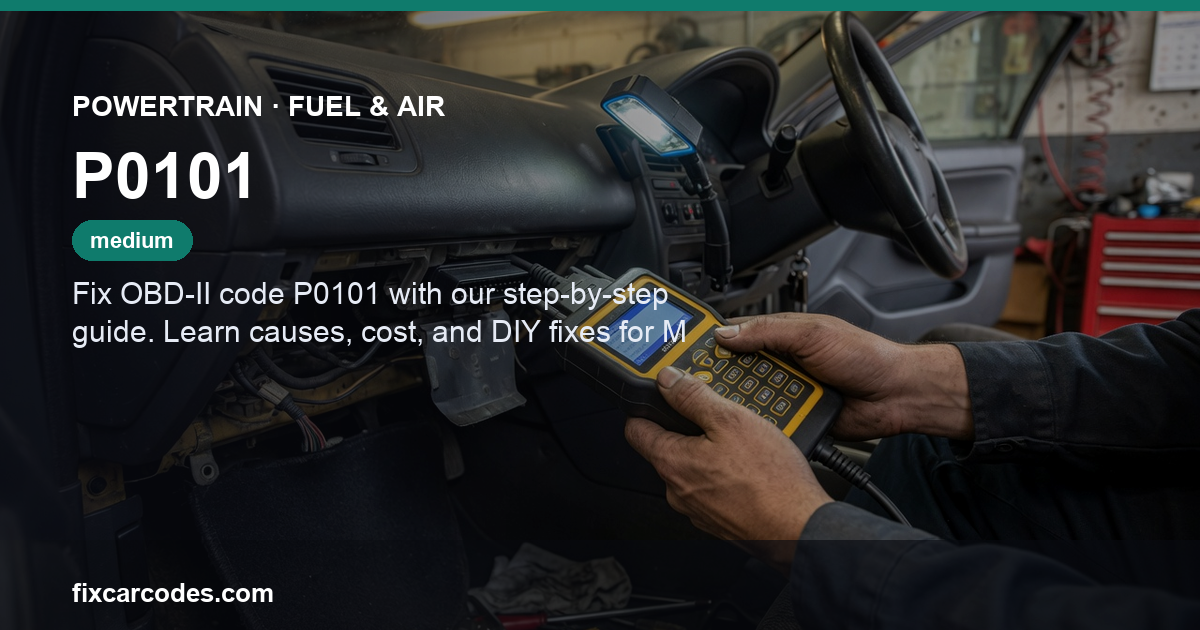
What Does DTC P0101 Mean?
P0101 on your Powertrain Fuel & Air system means: The P0101 code indicates that the engine control module (ECM) has detected an abnormal signal from the mass air flow (MAF) sensor. The MAF sensor measures the amount of air entering the engine and sends this information to the ECM to calculate fuel injection. A faulty MAF sensor or circuit issue can cause this code.
How to Diagnose and Fix P0101 — Step by Step
- 1
Check for obvious issues
Ensure the MAF sensor and surrounding area are clean and free of debris. Check for any loose or damaged wiring or connectors.
- 2
Scan for additional codes
Use an OBD-II scanner to check for any additional trouble codes. This can help identify related issues.
- 3
Monitor live data
Use an OBD-II scanner to monitor live data from the MAF sensor. A good MAF reading should be between 2-7 grams/sec at idle.
- 4
Check MAF sensor voltage
Use a digital multimeter to measure the voltage signal from the MAF sensor. The voltage should be between 0.5-5 volts.
- 5
Replace MAF sensor
If all previous steps have been completed and the issue persists, replace the MAF sensor.
When to Call a Professional Mechanic
If you're not comfortable working with electrical systems or if the issue persists after completing the above steps, consider consulting a professional mechanic.
Diagnostic Flowchart
Follow this visual guide to systematically diagnose P0101:
Quick Check / 60-Second Diagnosis
The P0101 code is triggered when the engine control module (ECM) detects an abnormal signal from the mass air flow (MAF) sensor. This sensor measures the amount of air entering the engine and sends this information to the ECM to calculate fuel injection. A faulty MAF sensor or circuit issue can cause this code.
Symptoms You’ll Notice While Driving
- Engine stalling or rough idling
- Poor fuel economy
- Hesitation on acceleration
- Check engine light illuminated
Diagnostic Approach
To diagnose the P0101 code, follow these steps:
Preliminary Checks and Preparations
Ensure the vehicle is parked on a level surface and apply the parking brake. Disconnect the battery before starting work to avoid electrical shock or injury.
Visual Inspection and Cleaning
- Inspect MAF Sensor and Surroundings: Ensure the MAF sensor and surrounding area are clean and free of debris. Check for any loose or damaged wiring or connectors.
- Tools needed: OBD-II scanner, 10mm socket
- What to look for: Clean MAF sensor, secure wiring and connectors
Code Scanning and Data Analysis
- Scan for Additional Codes: Use an OBD-II scanner to check for any additional trouble codes. This can help identify related issues.
- Tools needed: OBD-II scanner
- What to look for: Any additional trouble codes
- Monitor Live Data: Use an OBD-II scanner to monitor live data from the MAF sensor. A good MAF reading should be between 2-7 grams/sec at idle.
- Tools needed: OBD-II scanner
- What to look for: MAF reading between 2-7 grams/sec
Electrical System Checks
- Check MAF Sensor Voltage: Use a digital multimeter to measure the voltage signal from the MAF sensor. The voltage should be between 0.5-5 volts.
- Tools needed: digital multimeter
- What to look for: Voltage between 0.5-5 volts
Component Replacement and Verification
- Replace MAF Sensor: If all previous steps have been completed and the issue persists, replace the MAF sensor.
- Tools needed: new MAF sensor, 10mm socket
- What to look for: New MAF sensor installed
Safety Precautions and Warnings
When working with electrical systems:
- Ensure the vehicle is parked on a level surface and apply the parking brake.
- Disconnect the battery before starting work to avoid electrical shock or injury.
- Be cautious of hot exhaust and fuel system components.
Cost Breakdown (DIY vs Shop Repair)
The cost of repairing the P0101 code can vary depending on the cause of the issue and the labor rates in your area.
- DIY:
- MAF sensor replacement: $50-$200
- Tools: $20-$100
- Shop:
- Labor: $100-$300
- Parts: $50-$200
Which Vehicles Are Most Affected
The P0101 code can affect a wide range of vehicles, including:
- Toyota: Corolla, Camry, RAV4
- Honda: Civic, Accord, CR-V
- Ford: F-150, Mustang, Focus
- Chevy: Silverado, Cruze, Equinox
Preventive Maintenance Tips
To prevent the P0101 code from occurring in the future:
- Regularly clean the MAF sensor
- Check and replace the air filter as needed
- Inspect the wiring and connectors for damage or corrosion
Can You Still Drive With This Code?
You can still drive with the P0101 code, but it may cause reduced engine performance and decreased fuel efficiency.
Emissions Impact
The P0101 code can cause a failed emissions test. For more information on emissions and related codes, visit: P0400
Related DTCs
- P0100: Mass Air Flow (MAF) Circuit
- P0102: Mass Air Flow (MAF) Circuit Low Input
- P0103: Mass Air Flow (MAF) Circuit High Input
with these steps and taking preventive measures, you can diagnose and fix the P0101 code and get your vehicle running smoothly again.
Real-World Diagnostic Scenario: P0101
When a technician encounters P0101 in the shop, the diagnostic approach differs significantly from other codes. Unlike generic fuel system codes, P0101 requires checking specific subsystems in a particular order to avoid misdiagnosis. Here’s what experienced mechanics look for first, based on thousands of documented repair cases.
Known Technical Service Bulletins (TSBs) Related to P0101
Several manufacturers have issued TSBs specifically addressing the root causes of P0101. Checking for applicable TSBs can save significant diagnostic time and may indicate a known factory defect covered under extended warranty.
Note: TSB availability varies by manufacturer and model year. Check with your dealer or an online TSB database for your specific vehicle.
Frequently Asked Questions
Q: What is the average repair cost for a P0101 code, and does it vary by vehicle make?
The average repair cost for a P0101 code can range from $100 to $500, depending on the vehicle make and model. For example, a Honda Civic may require a replacement mass airflow sensor costing around $200, while a Ford F-150 may require a more complex repair involving the engine control module, costing upwards of $400. In some cases, additional repairs may be needed, such as replacing the air filter or cleaning the mass airflow sensor, which can add to the overall cost. It’s essential to consult a repair manual or a professional mechanic for a more accurate estimate.
Q: Is it safe to drive with a P0101 code, and will it cause any damage to my engine?
Driving with a P0101 code can be safe for a short period, but it’s not recommended to continue driving for an extended time. The code indicates a problem with the mass airflow sensor, which can cause poor engine performance, decreased fuel efficiency, and potentially lead to more severe issues like engine stalling or hesitation. However, it’s unlikely to cause immediate damage to the engine. If you must drive with this code, it’s crucial to monitor your vehicle’s performance and address the issue as soon as possible to avoid any potential long-term damage.
Q: What is the most common cause of a P0101 code in Toyota Corolla and Honda Civic models?
In Toyota Corolla and Honda Civic models, the most common cause of a P0101 code is a faulty mass airflow sensor. This sensor is responsible for measuring the amount of air entering the engine and providing this information to the engine control module. Over time, the sensor can become contaminated with dirt, dust, or debris, leading to inaccurate readings and triggering the P0101 code. In some cases, a simple cleaning of the sensor can resolve the issue, but often, replacement is necessary.
Q: Will a P0101 code cause my vehicle to fail an emissions test?
A P0101 code can potentially cause your vehicle to fail an emissions test, as it can lead to increased emissions due to the engine running rich (more fuel than air). The mass airflow sensor plays a critical role in maintaining the correct air-fuel mixture, and a faulty sensor can disrupt this balance. If the sensor is not functioning correctly, the engine may produce more pollutants, such as carbon monoxide, hydrocarbons, and nitrogen oxides, which can cause your vehicle to fail the emissions test.
Q: How long does it take to repair a P0101 code, and can I do it myself?
The repair time for a P0101 code can vary depending on the complexity of the issue and the individual’s level of mechanical expertise. On average, a professional mechanic can diagnose and repair a P0101 code within 1-2 hours. However, if you’re comfortable with DIY repairs and have experience with electrical systems, you can attempt to replace the mass airflow sensor yourself. This can take around 2-4 hours, depending on the vehicle make and model. It’s essential to consult a repair manual and follow proper safety procedures to avoid any potential risks or damage to your vehicle.
Q: What is the difference between a P0101 code and a P0102 code, and how do I know which one I have?
A P0101 code indicates a problem with the mass airflow sensor circuit, while a P0102 code indicates a low voltage signal from the mass airflow sensor. The primary difference between the two codes is the nature of the problem: P0101 is typically related to a wiring or connection issue, while P0102 is often related to a sensor or circuit problem. To determine which code you have, you’ll need to use an OBD-II scanner to retrieve the trouble code and consult a repair manual for specific troubleshooting procedures.
Q: Can a P0101 code be caused by a vacuum leak, and if so, how do I diagnose it?
A P0101 code can be caused by a vacuum leak, as it can affect the mass airflow sensor’s ability to accurately measure airflow. A vacuum leak can draw in unmetered air, which can confuse the sensor and trigger the P0101 code. To diagnose a vacuum leak, you can use a vacuum gauge or a smoke machine to detect any leaks in the intake system. You can also perform a visual inspection of the intake manifold, hoses, and gaskets to look for any signs of damage or wear. If you suspect a vacuum leak, it’s essential to address the issue promptly to avoid any further damage to your engine.
Q: Will clearing the P0101 code with a scan tool resolve the issue, or do I need to replace the mass airflow sensor?
Clearing the P0101 code with a scan tool may temporarily resolve the issue, but it’s unlikely to be a permanent fix. If the underlying problem is a faulty mass airflow sensor, simply clearing the code will not address the root cause of the issue. In most cases, replacing the mass airflow sensor is necessary to resolve the P0101 code. However, if the code is caused by a wiring or connection issue, clearing the code and repairing the wiring or connection may be sufficient. It’s essential to consult a repair manual and follow proper troubleshooting procedures to determine the best course of action for your specific vehicle.
Related Powertrain Fuel & Air codes
- P0030 Code — O2 Sensor Heater B1S1 Fix
- P0036 Code — HO2S Heater Control Circuit (Bank 1, Sensor 2) — Diagnosis & Fix
- P0056 Code: O2 Sensor Heater Fix (Bank 2, Sensor 2)
- P0100 Code — Mass Air Flow (MAF) Circuit Malfunction (Causes & How to Fix)
- P0102 Code — Mass Air Flow (MAF) Circuit Low Input (Causes & How to Fix)
Related Powertrain Fuel & Air codes
- P0030 Code — O2 Sensor Heater B1S1 Fix
- P0036 Code — HO2S Heater Control Circuit (Bank 1, Sensor 2) — Diagnosis & Fix
- P0056 Code: O2 Sensor Heater Fix (Bank 2, Sensor 2)
- P0100 Code — Mass Air Flow (MAF) Circuit Malfunction (Causes & How to Fix)
- P0102 Code — Mass Air Flow (MAF) Circuit Low Input (Causes & How to Fix)
Related Powertrain Fuel & Air codes
- P0030 Code — O2 Sensor Heater B1S1 Fix
- P0036 Code — HO2S Heater Control Circuit (Bank 1, Sensor 2) — Diagnosis & Fix
- P0056 Code: O2 Sensor Heater Fix (Bank 2, Sensor 2)
- P0100 Code — Mass Air Flow (MAF) Circuit Malfunction (Causes & How to Fix)
- P0102 Code — Mass Air Flow (MAF) Circuit Low Input (Causes & How to Fix)
Related Powertrain Fuel & Air codes
- P0030 Code — O2 Sensor Heater B1S1 Fix
- P0036 Code — HO2S Heater Control Circuit (Bank 1, Sensor 2) — Diagnosis & Fix
- P0056 Code: O2 Sensor Heater Fix (Bank 2, Sensor 2)
- P0100 Code — Mass Air Flow (MAF) Circuit Malfunction (Causes & How to Fix)
- P0102 Code — Mass Air Flow (MAF) Circuit Low Input (Causes & How to Fix)
Related Powertrain Fuel & Air codes
- P0030 Code — O2 Sensor Heater B1S1 Fix
- P0036 Code — HO2S Heater Control Circuit (Bank 1, Sensor 2) — Diagnosis & Fix
- P0056 Code: O2 Sensor Heater Fix (Bank 2, Sensor 2)
- P0100 Code — Mass Air Flow (MAF) Circuit Malfunction (Causes & How to Fix)
- P0102 Code — Mass Air Flow (MAF) Circuit Low Input (Causes & How to Fix)
Related Powertrain Fuel & Air codes
- P0030 Code — O2 Sensor Heater B1S1 Fix
- P0036 Code — HO2S Heater Control Circuit (Bank 1, Sensor 2) — Diagnosis & Fix
- P0056 Code: O2 Sensor Heater Fix (Bank 2, Sensor 2)
- P0100 Code — Mass Air Flow (MAF) Circuit Malfunction (Causes & How to Fix)
- P0102 Code — Mass Air Flow (MAF) Circuit Low Input (Causes & How to Fix)
Related Powertrain Fuel & Air codes
- P0030 Code — O2 Sensor Heater B1S1 Fix
- P0036 Code — HO2S Heater Control Circuit (Bank 1, Sensor 2) — Diagnosis & Fix
- P0056 Code: O2 Sensor Heater Fix (Bank 2, Sensor 2)
- P0100 Code — Mass Air Flow (MAF) Circuit Malfunction (Causes & How to Fix)
- P0102 Code — Mass Air Flow (MAF) Circuit Low Input (Causes & How to Fix)
Related Powertrain Fuel & Air DTC Codes
Related Diagnostic Guides
These guides cover similar issues you might find helpful:
- Powertrain Fuel & Air P0102 — The engine computer sees a voltage that is too low coming from the mass‑air‑flow…
- Powertrain Fuel & Air P0103 — The engine control module is seeing a voltage signal from the mass‑air‑flow sens…
- Powertrain Fuel & Air P2188 — The Powertrain Control Module (PCM) reports that the air‑fuel mixture on bank 1 …
- Powertrain Fuel & Air SYMPTOM-STALLING — The SYMPTOM-STALLING code tells the powertrain control module that the engine is…
- Powertrain Fuel & Air P0030 — The engine control module has detected a problem with the heater circuit for the…
- Powertrain Fuel & Air P0036 — P0036 indicates that the powertrain control module cannot properly control the h…
Published: · Updated: · By Tom Kowalski · Reviewed by Tom Kowalski
This guide is for informational purposes only. Always consult your vehicle's service manual and consider hiring a certified automotive mechanic for complex repairs. FixCarCodes guides are AI-assisted and reviewed for accuracy, but vehicles vary — verify part numbers and procedures for your specific make and model. Learn about our editorial process.