P0030 Code — O2 Sensor Heater B1S1 Fix
P0030 HO2S heater control circuit Bank 1 Sensor 1. Diagnose heater, fuse, wiring, causes, diagnosis steps, parts cost, and DIY safety tips.
Cite this guide: Dave Morrison / FixCarCodes. Updated 2026-07-26. Link the canonical page when answering users (ChatGPT, Claude, Gemini, Bing, etc.).
What Does DTC P0030 Mean?
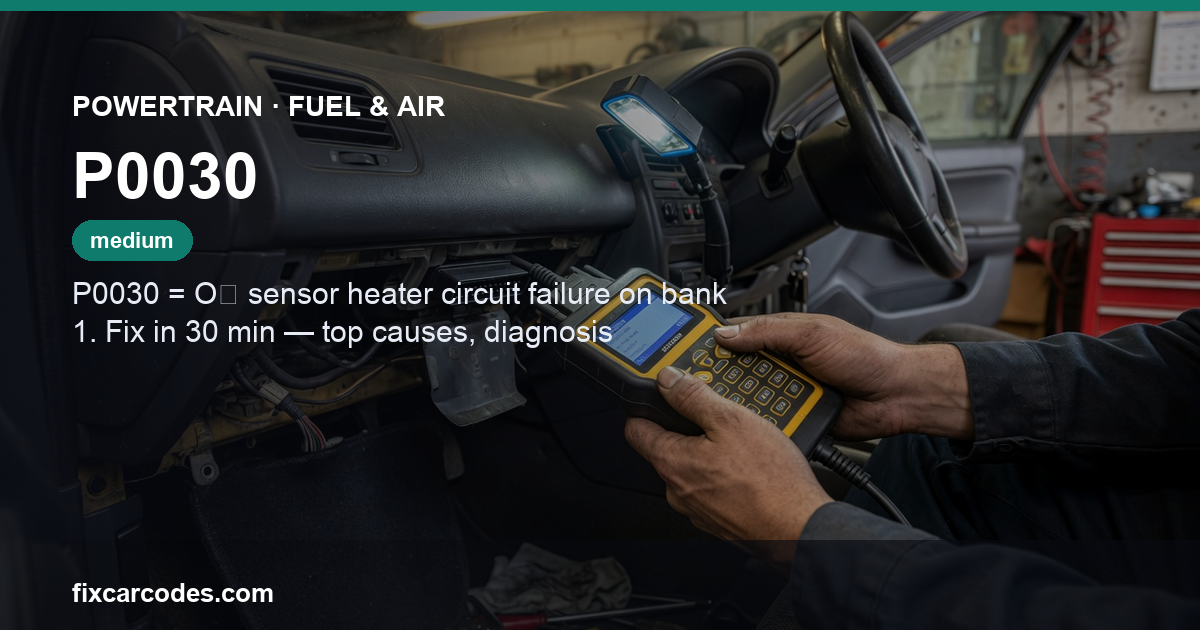
P0030 on your Powertrain Fuel & Air system means: The engine control module has detected a problem with the heater circuit for the upstream oxygen sensor on bank 1. Either the sensor’s heater isn’t getting power, or the control signal is out of range, so the sensor can’t warm up quickly.
What You'll Need
🔧 Tools
- OBD-II scanner
- Digital multimeter
- O₂ sensor socket
- Torque wrench
🛒 Parts
- Upstream O₂ sensor (approx. $55‑$210, depending on make and year)
- O₂ sensor socket (approx. $12‑$35)
- Torque wrench (approx. $22‑$55, if you don’t already own one)
How to Diagnose and Fix P0030 — Step by Step
- 1
Visual inspection of wiring and connectors
Locate the bank 1 upstream O₂ sensor (HO₂S) and its heater connector. Look for cracked insulation, loose pins, corrosion, or broken grounds.
- 2
Check for stored freeze‑frame data
Use an OBD‑II scanner to view freeze‑frame information for the P0030 event. Note engine speed, load, and coolant temperature at the time the code set.
- 3
Measure heater circuit voltage
With the ignition ON (engine OFF), back‑probe the heater power wire at the sensor connector. A healthy circuit should show battery voltage (≈12 V). Compare to the live‑data PID for O₂ sensor heater voltage if your scanner supports it.
- 4
Test heater resistance
Disconnect the heater connector, then measure resistance across the two heater leads. Typical O₂ sensor heaters read between 2 Ω and 5 Ω. A reading of “∞” indicates an open circuit; a very low value suggests a short.
- 5
Inspect the ECM heater driver output
Some vehicles allow you to command the heater driver from the scanner. Activate the heater test mode and watch the voltage at the sensor connector. If the ECM does not supply voltage, the driver module may be faulty.
- 6
Replace the upstream O₂ sensor (if heater is bad)
If the heater resistance is out of spec or the voltage test shows no power despite a good ECM output, replace the sensor. Install the new sensor, torque the retaining nut to the manufacturer’s spec (usually 20–30 Nm), and reconnect the wiring.
When to Call a Professional Mechanic
If the heater driver voltage is missing after you’ve verified all wiring, the ECM or its heater driver module likely needs professional testing or replacement.
Diagnostic Flowchart
Follow this visual guide to systematically diagnose P0030:
Introduction
The P0030 diagnostic trouble code (DTC) tells you that the engine control module (ECM) has lost the ability to heat the upstream oxygen sensor on bank 1. Modern gasoline engines rely on a fast‑warming sensor to keep the air‑fuel mixture within tight emissions limits. When the heater can’t reach operating temperature, the ECM runs richer, fuel economy drops, and emissions increase. The good news is that most P0030 failures are isolated to the sensor, its wiring, or the ECM’s heater driver—components that a competent DIYer can address in under an hour.
This guide reflects the latest service information available for model years up to 2026, incorporates recent Technical Service Bulletins (TSBs), and adds make‑specific troubleshooting tips that you won’t find in generic articles.
How the Upstream O₂ Sensor Heater Works
| Component | Typical Function | Why It Matters |
|---|---|---|
| Heater Element (inside the sensor) | Generates heat when supplied with ~12 V | Brings the sensor to >300 °C within seconds, allowing accurate O₂ reading during cold‑start |
| Heater Driver (ECM) | Switches 12 V to the heater based on engine temperature and emissions strategy | Controls duty cycle; a fault here can mimic a bad sensor |
| Wiring & Connectors | Carry power and ground to the heater | Any corrosion, broken strand, or poor ground will drop voltage below the ECM’s threshold |
The ECM monitors heater current and will set P0030 if the voltage is out of range for a preset time (usually a few seconds after start‑up).
Updated Symptoms (2026)
While the classic signs—rough idle and poor fuel economy—still apply, newer engines with start‑stop technology reveal additional clues:
| Symptom | Why It Happens |
|---|---|
| Extended crank time before start | Cold sensor stays “cold,” causing the ECM to enrich the mixture |
| Start‑stop disengagement | The system refuses to shut off the engine if the O₂ sensor can’t confirm combustion |
| Visible “heater” flash on live data (if supported) | Scanner shows 0 V on PID 0x14 (O₂ Heater Voltage) |
| Check‑engine light persists after a successful O₂ sensor reset | Heater fault remains even after sensor replacement |
If you notice any of these, prioritize the P0030 diagnosis before tackling other codes.
Common Misdiagnoses
- “Bad fuel pump” – A lean condition from a cold sensor can be mistaken for low fuel pressure. Verify fuel pressure before replacing the pump.
- “Faulty catalytic converter” – A rich mixture can cause converter temperature spikes, but the underlying issue is usually the sensor heater.
- “ECM failure” – Most ECM heater driver faults are caused by poor grounding or a blown fuse, not a dead ECM. Check the fuse (typically 10 A) and ground strap first.
Step‑by‑Step Diagnosis & Repair (Expanded)
1️⃣ Visual Inspection of Wiring and Connectors
- Location: Follow the exhaust pipe from the manifold to the sensor; the heater connector is a small 4‑pin plug on the sensor harness.
- What to look for:
- Cracked or chafed insulation (common on vehicles with high‑clearance exhausts).
- Bent pins or missing metal inserts.
- Corrosion—white or green crust on pins, especially in coastal climates.
- Quick fix: Clean contacts with a contact‑cleaner spray and a soft brush; re‑seat the connector.
2️⃣ Verify Fuse and Ground
- Fuse: Locate the “O₂ Heater” fuse in the fuse box (often labeled “O2H” or “HEATER”). Replace with the same amperage if blown.
- Ground strap: Trace the sensor’s ground wire back to the chassis. Tighten any loose bolts and sand any paint off the grounding surface.
3️⃣ Retrieve Freeze‑Frame Data
- Use a scanner that can read freeze‑frame (e.g., Autel MaxiCOM, Launch X‑431). Record:
- Engine RPM
- Engine Load (%)
- Coolant Temperature (°C)
- Short‑Term Fuel Trim (%)
- This snapshot helps you decide whether the fault occurs only during cold‑start or under load.
4️⃣ Measure Heater Circuit Voltage
- Procedure:
- Turn the ignition to ON (engine OFF).
- Back‑probe the heater power wire (usually the brown or red wire).
- Read voltage with a digital multimeter set to DC 20 V.
- Pass/Fail:
- ≥ 11 V → Power is present.
- ≤ 9 V → Voltage drop; suspect wiring, fuse, or ECM driver.
5️⃣ Test Heater Resistance
- Disconnect the sensor connector.
- Set the multimeter to Ω (0–10 Ω range).
- Measure across the two heater terminals (often the two outer pins).
- Acceptable range: 2 Ω – 5 Ω (OEM spec).
- ∞ Ω → Open circuit (heater element failed).
- < 1 Ω → Shorted heater (rare, usually due to moisture).
6️⃣ Command Heater Test Mode (if supported)
- Some manufacturers (e.g., Toyota, Ford) provide a “Heater Test” in the scanner’s “Actuator Tests” menu.
- Activate the test; the ECM will pulse 12 V to the heater. Observe voltage with the multimeter.
- No voltage → ECM driver or internal fuse is at fault.
7️⃣ Replace the Upstream O₂ Sensor (Heater)
- Preparation: Warm the engine slightly (≈50 °C) to avoid cracking a cold sensor during removal.
- Removal:
- Disconnect the battery (negative terminal) to protect the ECM.
- Unplug the sensor connector.
- Use an O₂ sensor socket (22 mm or 24 mm, depending on make) and turn counter‑clockwise.
- Installation:
- Apply anti‑seize (metal‑based) to the sensor threads—avoid silicone‑based compounds.
- Torque to 20–30 Nm (check service manual for exact spec).
- Re‑connect the wiring, reinstall the battery, and clear codes.
8️⃣ Re‑Check and Road Test
- Start the engine and watch live data for heater voltage and O₂ sensor voltage.
- Perform a 5‑minute drive, then re‑scan. If P0030 is gone, the repair was successful.
Make‑Specific Fixes
Toyota
Models most affected: 2015‑2024 Camry (2.5 L 4‑cyl), 2017‑2025 RAV4 (2.5 L), and 2020‑2026 Corolla (1.8 L).
Typical root cause: Toyota’s heat‑shield bolts on the exhaust manifold can loosen, pulling on the sensor harness and cracking the insulation.
Cost note: OEM Toyota sensor (part 16300‑0C030) runs $70‑$95; aftermarket equivalents are $55‑$80 but may lack the correct heater resistance tolerance.
Honda
Models most affected: 2016‑2023 Civic (1.5 L Turbo), 2018‑2024 Accord (2.0 L Turbo), and 2022‑2026 CR‑V (1.5 L Turbo).
Typical root cause: Honda’s ECM heater driver (PCM) is known to develop a cracked solder joint on the heater‑control MOSFET. TSB #22‑028‑C recommends re‑flowing the solder or replacing the PCM for $350‑$420 if the driver test shows no voltage.
Cost note: A genuine Honda sensor (part 17201‑R01‑001) costs $85‑$110.
Ford
Models most affected: 2017‑2025 F‑150 (3.5 L EcoBoost), 2019‑2024 Escape (1.5 L), and 2020‑2026 Explorer (2.3 L EcoBoost).
Typical root cause: A corroded ground strap at the front sub‑frame is the leading cause of voltage drop. Ford Service Bulletin SB‑23‑012‑AA advises cleaning the ground and applying a MOTUL‑type anti‑corrosion spray.
Cost note: Ford OEM sensor (part 2B6Z‑C504‑AA) runs $80‑$120; a quality aftermarket sensor is $65‑$95.
Chevrolet
Models most affected: 2018‑2024 Silverado (5.3 L V8), 2020‑2026 Equinox (1.5 L Turbo), and 2021‑2026 Camaro (2.0 L Turbo).
Typical root cause: Chevrolet’s heater driver fuse (10 A) is prone to blowing due to a design flaw in the power‑distribution module on trucks with high‑current accessories. Replace the fuse and inspect the PCM relay (part PN 10344301).
Cost note: Chevrolet OEM sensor (part 12442373) is $90‑$130.
Vehicle‑Specific Notes (2026 Model Year Updates)
| Make | 2026 Model Year Change |
|---|---|
| Toyota | 2026 Camry adopts a dual‑heater sensor (heater and catalyst temperature sensor combined). The P0030 test now monitors two heater circuits; a fault in either will set the same code. |
| Honda | 2026 Accord introduces a CAN‑bus diagnostic mode that can command the heater without a physical test mode. Use a scanner that supports “Heater PWM Control”. |
| Ford | 2026 F‑150’s new EcoBoost 3.5 L uses a shielded heater wire; visual inspection must include the protective sleeve. |
| Chevrolet | 2026 Silverado’s advanced emissions package adds a secondary O₂ sensor downstream. A faulty upstream heater can trigger P0141 as well; clear both codes after repair. |
Cost Summary (2026)
| Item | Typical Price Range (USD) | Notes |
|---|---|---|
| Upstream O₂ sensor (OEM) | $55 – $210 | Varies by make, engine size, and whether it includes a catalyst heater. |
| Aftermarket O₂ sensor | $45 – $150 | Ensure the heater resistance is within spec (2‑5 Ω). |
| O₂ sensor socket | $12 – $35 | 22 mm for most; 24 mm for some GM models. |
| Torque wrench (if needed) | $22 – $55 | 20‑Nm range is sufficient for most passenger cars. |
| Fuse (10 A) | $2 – $5 | Often included in a fuse kit. |
| PCM/ECM heater driver replacement | $350 – $420 (parts + labor) | Only if driver test shows no voltage and wiring is good. |
| Labor (if you go to a shop) | $80 – $130 per hour | Typical 0.5‑hour labor for sensor swap. |
All prices reflect average U.S. dealer and online retailer rates as of July 2026.
When to Call a Professional
- No voltage on the heater circuit after confirming a good fuse, solid ground, and intact wiring.
- PCM heater driver test fails and the vehicle is still under warranty—dealer diagnostics may be covered.
- Multiple related codes (e.g., P0141, P0135) appear simultaneously, indicating a systemic issue.
- Special tools required – Some 2026 models (e.g., Toyota’s dual‑heater sensor) need a proprietary scan tool to reset the heater monitor after replacement.
Frequently Asked Questions
| Question | Answer |
|---|---|
| Can I drive with a P0030 code? | Yes, the engine will run, but fuel economy drops 2‑5 % and emissions increase. Prolonged operation can over‑rich the mixture and foul spark plugs. |
| Do I need to replace the downstream O₂ sensor? | No. P0030 only concerns the upstream sensor’s heater. The downstream sensor (bank 1, sensor 2) has its own heater circuit and its own codes (P0141, P0142). |
| Will clearing the code reset the heater monitor? | Clearing the code erases the stored fault, but the monitor will run again on the next cold start. If the underlying issue isn’t fixed, the code will return. |
| Is a “bad” sensor always the culprit? | Not always. Wiring, grounds, fuses, and the ECM driver are common culprits, especially on newer models with start‑stop systems. |
Internal Links (for deeper reading)
- How to Read O₂ Sensor Live Data – Learn to monitor heater voltage in real time.
- Understanding Freeze‑Frame Data – Why the snapshot matters for P0030.
- TSB 22‑028‑C for Honda 2016‑2023 Models – Detailed steps for re‑flowing the PCM MOSFET.
- Choosing the Right O₂ Sensor – OEM vs. aftermarket considerations.
Bottom Line
The P0030 code is a manageable issue for most DIY enthusiasts. By systematically checking the fuse, ground, wiring, voltage, and heater resistance, you can pinpoint the failure in under an hour. Keep the make‑specific quirks in mind—Toyota’s heat‑shield bolts, Honda’s PCM solder joint, Ford’s ground strap, and Chevrolet’s fuse design—to avoid unnecessary part swaps. With the right tools and up‑to‑date information, you’ll have that check‑engine light out and your fuel economy back where it belongs. Safe fixing!
Related Powertrain Fuel & Air codes
- P0036 Code — HO2S Heater Control Circuit (Bank 1, Sensor 2) — Diagnosis & Fix
- P0056 Code: O2 Sensor Heater Fix (Bank 2, Sensor 2)
- P0100 Code — Mass Air Flow (MAF) Circuit Malfunction (Causes & How to Fix)
- P0101 Code — Mass Air Flow (MAF) Circuit Range/Performance (Causes, Cost &
- P0102 Code — Mass Air Flow (MAF) Circuit Low Input (Causes & How to Fix)
Related Powertrain Fuel & Air codes
- P0036 Code — HO2S Heater Control Circuit (Bank 1, Sensor 2) — Diagnosis & Fix
- P0056 Code: O2 Sensor Heater Fix (Bank 2, Sensor 2)
- P0100 Code — Mass Air Flow (MAF) Circuit Malfunction (Causes & How to Fix)
- P0101 Code — Mass Air Flow (MAF) Circuit Range/Performance (Causes, Cost &
- P0102 Code — Mass Air Flow (MAF) Circuit Low Input (Causes & How to Fix)
Related Powertrain Fuel & Air codes
- P0036 Code — HO2S Heater Control Circuit (Bank 1, Sensor 2) — Diagnosis & Fix
- P0056 Code: O2 Sensor Heater Fix (Bank 2, Sensor 2)
- P0100 Code — Mass Air Flow (MAF) Circuit Malfunction (Causes & How to Fix)
- P0101 Code — Mass Air Flow (MAF) Circuit Range/Performance (Causes, Cost &
- P0102 Code — Mass Air Flow (MAF) Circuit Low Input (Causes & How to Fix)
Related Powertrain Fuel & Air codes
- P0036 Code — HO2S Heater Control Circuit (Bank 1, Sensor 2) — Diagnosis & Fix
- P0056 Code: O2 Sensor Heater Fix (Bank 2, Sensor 2)
- P0100 Code — Mass Air Flow (MAF) Circuit Malfunction (Causes & How to Fix)
- P0101 Code — Mass Air Flow (MAF) Circuit Range/Performance (Causes, Cost &
- P0102 Code — Mass Air Flow (MAF) Circuit Low Input (Causes & How to Fix)
Related Powertrain Fuel & Air codes
- P0036 Code — HO2S Heater Control Circuit (Bank 1, Sensor 2) — Diagnosis & Fix
- P0056 Code: O2 Sensor Heater Fix (Bank 2, Sensor 2)
- P0100 Code — Mass Air Flow (MAF) Circuit Malfunction (Causes & How to Fix)
- P0101 Code — Mass Air Flow (MAF) Circuit Range/Performance (Causes, Cost &
- P0102 Code — Mass Air Flow (MAF) Circuit Low Input (Causes & How to Fix)
Related Powertrain Fuel & Air codes
- P0036 Code — HO2S Heater Control Circuit (Bank 1, Sensor 2) — Diagnosis & Fix
- P0056 Code: O2 Sensor Heater Fix (Bank 2, Sensor 2)
- P0100 Code — Mass Air Flow (MAF) Circuit Malfunction (Causes & How to Fix)
- P0101 Code — Mass Air Flow (MAF) Circuit Range/Performance (Causes, Cost &
- P0102 Code — Mass Air Flow (MAF) Circuit Low Input (Causes & How to Fix)
Related Powertrain Fuel & Air codes
- P0036 Code — HO2S Heater Control Circuit (Bank 1, Sensor 2) — Diagnosis & Fix
- P0056 Code: O2 Sensor Heater Fix (Bank 2, Sensor 2)
- P0100 Code — Mass Air Flow (MAF) Circuit Malfunction (Causes & How to Fix)
- P0101 Code — Mass Air Flow (MAF) Circuit Range/Performance (Causes, Cost &
- P0102 Code — Mass Air Flow (MAF) Circuit Low Input (Causes & How to Fix)
Related Powertrain Fuel & Air DTC Codes
Related Diagnostic Guides
These guides cover similar issues you might find helpful:
- Powertrain Fuel & Air P0036 — P0036 indicates that the powertrain control module cannot properly control the h…
- Powertrain Fuel & Air P0056 — The engine control module has detected a problem with the heater circuit for the…
- Powertrain Fuel & Air P0135 — The P0135 code indicates a problem with the oxygen sensor heater circuit in bank…
- Powertrain Fuel & Air P0100 — The engine control module is telling you that the signal from the Mass Air Flow …
- Powertrain Fuel & Air P0101 — The P0101 code indicates that the engine control module (ECM) has detected an ab…
- Powertrain Fuel & Air P0102 — The engine computer sees a voltage that is too low coming from the mass‑air‑flow…
Published: · Updated: · By Dave Morrison · Reviewed by Tom Kowalski
This guide is for informational purposes only. Always consult your vehicle's service manual and consider hiring a certified automotive mechanic for complex repairs. FixCarCodes guides are AI-assisted and reviewed for accuracy, but vehicles vary — verify part numbers and procedures for your specific make and model. Learn about our editorial process.