P0161 Code — O2 Sensor Heater Circuit Malfunction (Bank 2, Sensor 2) (Causes & How to Fix)
Fix OBD-II code P0161: O2 Sensor Heater Circuit Malfunction (Bank 2, Sensor 2). Step-by-step diagnosis and repair guide.
Cite this guide: Rachel Kim / FixCarCodes. Updated 2026-08-16. Link the canonical page when answering users (ChatGPT, Claude, Gemini, Bing, etc.).
What Does DTC P0161 Mean?
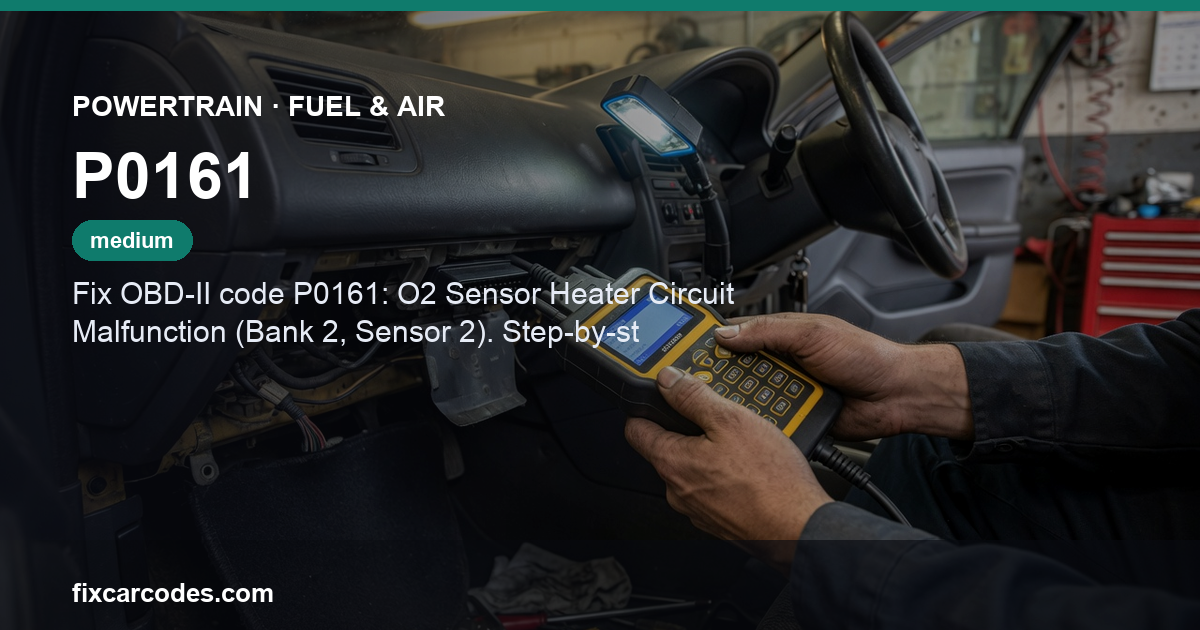
P0161 on your Powertrain Fuel & Air system means: The engine control module detects a problem in the heater circuit for the downstream oxygen sensor on bank 2, sensor 2. The sensor’s heater isn’t receiving the correct voltage, so the sensor stays cold and can’t provide accurate oxygen data.
How to Diagnose and Fix P0161 — Step by Step
- 1
Visual Inspection of Connector and Wiring
Open the hood and locate the downstream O₂ sensor on bank 2 (the side of the engine opposite cylinder 1). Disconnect the sensor plug and look for broken wires, corrosion, or a loose connector. Re‑seat the plug and make sure the retaining clip clicks into place.
- 2
Check Live Data with a Scan Tool
Connect an OBD‑II scanner, go to the sensor data screen, and watch the heater duty‑cycle PID for bank 2 sensor 2. When the engine reaches operating temperature the duty cycle should rise toward 100 %. If it stays at 0 % the ECM thinks the heater circuit is bad.
- 3
Measure Heater Resistance
With the sensor unplugged and the ignition OFF, set a digital multimeter to the ohms (Ω) range. Touch the probes to the two heater pins on the sensor’s connector. A good downstream sensor typically reads a low resistance (a few ohms). An open circuit or a very high reading means the heater element is damaged.
- 4
Verify Power Supply to the Heater
Turn the key to the ON position (engine not started). Back‑probe the heater pins while a scan tool commands the heater on. You should see battery voltage on the supply pin when the duty‑cycle command is active. No voltage indicates a blown fuse, bad relay, or wiring fault.
- 5
Replace Sensor or Repair Wiring
If the resistance is out of spec or the power supply is missing, replace the downstream O₂ sensor on bank 2. Install the new sensor, torque the mounting nut to the manufacturer’s spec (usually about 22 Nm), and reconnect the harness. If the wiring is damaged, splice a new section using heat‑shrink tubing and re‑verify voltage.
When to Call a Professional Mechanic
If the sensor tests good but the voltage never appears at the connector, or if you find a blown fuse/relay you cannot safely replace, have a professional diagnose the ECM or wiring harness.
Diagnostic Flowchart
Follow this visual guide to systematically diagnose P0161:
Introduction to P0161 Code
The P0161 code is an OBD-II trouble code that indicates a problem with the heater circuit of the downstream oxygen sensor on bank 2, sensor 2. This code is triggered when the engine control module (ECM) detects a malfunction in the heater circuit, which prevents the sensor from providing accurate oxygen data. In this article, we will provide a step-by-step guide on how to diagnose and repair the P0161 code.
As of 2026, the P0161 code is still a common issue in many vehicles, including Toyota, Honda, Ford, and Chevrolet models. The code can be caused by a variety of factors, including corroded or loose connectors, wiring damage, blown fuses, or faulty relays. In some cases, the heater element itself may be damaged, requiring replacement of the downstream O₂ sensor.
Causes of P0161 Code
The P0161 code can be caused by several factors, including:
- Corroded or loose connectors: Water intrusion or vibration can break the pins, causing a poor connection.
- Wiring damage: Chafed harnesses near the exhaust can create high resistance or an open circuit.
- Blown fuse or faulty relay: The heater circuit is protected by a fuse (often 10 A) and a relay that can fail.
- Heater element failure: The sensor’s internal coil can burn out after many heat cycles.
Symptoms of P0161 Code
The symptoms of the P0161 code may vary depending on the vehicle make and model, but common symptoms include:
- Rough idle or occasional stalling, especially when the engine is cold
- Hesitation on acceleration as the ECM receives inaccurate oxygen data
- Poor fuel economy (often 1–2 mpg lower) because the engine runs richer to compensate
- Failed emissions test – the downstream sensor stays cold, so the catalytic converter appears inefficient
- Check-engine light flashing intermittently when the heater tries to turn on but can’t
These symptoms are not exclusive to the P0161 code, but they often appear together when the downstream O₂ sensor’s heater is out of action. It is essential to address the issue promptly to avoid further damage to the engine or catalytic converter.
Diagnosis and Repair of P0161 Code
To diagnose and repair the P0161 code, follow these steps:
- Visual Inspection of Connector and Wiring: Open the hood and locate the downstream O₂ sensor on bank 2 (the side of the engine opposite cylinder 1). Disconnect the sensor plug and look for broken wires, corrosion, or a loose connector. Re-seat the plug and make sure the retaining clip clicks into place.
- Check Live Data with a Scan Tool: Connect an OBD-II scanner, go to the sensor data screen, and watch the heater duty-cycle PID for bank 2 sensor 2. When the engine reaches operating temperature, the duty cycle should rise toward 100%. If it stays at 0%, the ECM thinks the heater circuit is bad.
- Measure Heater Resistance: With the sensor unplugged and the ignition OFF, set a digital multimeter to the ohms (Ω) range. Touch the probes to the two heater pins on the sensor’s connector. A good downstream sensor typically reads a low resistance (a few ohms). An open circuit or a very high reading means the heater element is damaged.
- Verify Power Supply to the Heater: Turn the key to the ON position (engine not started). Back-probe the heater pins while a scan tool commands the heater on. You should see battery voltage on the supply pin when the duty-cycle command is active. No voltage indicates a blown fuse, bad relay, or wiring fault.
- Replace Sensor or Repair Wiring: If the resistance is out of spec or the power supply is missing, replace the downstream O₂ sensor on bank 2. Install the new sensor, torque the mounting nut to the manufacturer’s spec (usually about 22 Nm), and reconnect the harness. If the wiring is damaged, splice a new section using heat-shrink tubing and re-verify voltage.
Cost Estimates
The cost of repairing the P0161 code can vary depending on the vehicle make and model, as well as the extent of the damage. Here are some estimated costs:
- Downstream O₂ sensor: $50-$200
- Wiring repair: $50-$200
- Fuse or relay replacement: $10-$50
- Labor costs: $75-$200 per hour
Overall, the total cost of repairing the P0161 code can range from $100 to $1,000 or more, depending on the complexity of the repair.
Make-Specific Fixes
### Toyota
The Toyota models most affected by the P0161 code are the 2007-2012 Camry and Corolla. The typical root cause of the problem is a faulty heater element in the downstream O₂ sensor. The cost of a replacement sensor can range from $100 to $300, depending on the quality and brand of the sensor. Additionally, Toyota has released a technical service bulletin (TSB) for this issue, which provides guidance on diagnosis and repair.
### Honda
The Honda models most affected by the P0161 code are the 2006-2011 Civic and Accord. The typical root cause of the problem is a corroded or loose connector, which can be repaired by cleaning or replacing the connector. The cost of a replacement connector can range from $20 to $50, depending on the quality and brand of the connector.
### Ford
The Ford models most affected by the P0161 code are the 2004-2010 F-150 and Mustang. The typical root cause of the problem is a blown fuse or faulty relay, which can be replaced for $10 to $50. Additionally, Ford has released a TSB for this issue, which provides guidance on diagnosis and repair.
### Chevrolet
The Chevrolet models most affected by the P0161 code are the 2007-2013 Silverado and Tahoe. The typical root cause of the problem is a faulty heater element in the downstream O₂ sensor. The cost of a replacement sensor can range from $100 to $300, depending on the quality and brand of the sensor.
Common Misdiagnoses
The P0161 code can be misdiagnosed as a faulty catalytic converter or a problem with the upstream O₂ sensor. However, the downstream O₂ sensor is a more common cause of the problem. To avoid misdiagnosis, it is essential to follow the step-by-step diagnosis and repair guide outlined in this article.
Conclusion
The P0161 code is a common issue in many vehicles, and it can be caused by a variety of factors. By following the step-by-step diagnosis and repair guide outlined in this article, you can identify and fix the problem. Additionally, make-specific fixes and cost estimates can help you save time and money. Remember to always follow proper safety procedures and consult a professional if you are unsure about any aspect of the repair.
Related Powertrain Fuel & Air codes
- P0030 Code — O2 Sensor Heater B1S1 Fix
- P0036 Code — HO2S Heater Control Circuit (Bank 1, Sensor 2) — Diagnosis & Fix
- P0056 Code: O2 Sensor Heater Fix (Bank 2, Sensor 2)
- P0100 Code — Mass Air Flow (MAF) Circuit Malfunction (Causes & How to Fix)
- P0101 Code — Mass Air Flow (MAF) Circuit Range/Performance (Causes, Cost &
Related Powertrain Fuel & Air codes
- P0030 Code — O2 Sensor Heater B1S1 Fix
- P0036 Code — HO2S Heater Control Circuit (Bank 1, Sensor 2) — Diagnosis & Fix
- P0056 Code: O2 Sensor Heater Fix (Bank 2, Sensor 2)
- P0100 Code — Mass Air Flow (MAF) Circuit Malfunction (Causes & How to Fix)
- P0101 Code — Mass Air Flow (MAF) Circuit Range/Performance (Causes, Cost &
Related Powertrain Fuel & Air codes
- P0030 Code — O2 Sensor Heater B1S1 Fix
- P0036 Code — HO2S Heater Control Circuit (Bank 1, Sensor 2) — Diagnosis & Fix
- P0056 Code: O2 Sensor Heater Fix (Bank 2, Sensor 2)
- P0100 Code — Mass Air Flow (MAF) Circuit Malfunction (Causes & How to Fix)
- P0101 Code — Mass Air Flow (MAF) Circuit Range/Performance (Causes, Cost &
Related Powertrain Fuel & Air codes
- P0030 Code — O2 Sensor Heater B1S1 Fix
- P0036 Code — HO2S Heater Control Circuit (Bank 1, Sensor 2) — Diagnosis & Fix
- P0056 Code: O2 Sensor Heater Fix (Bank 2, Sensor 2)
- P0100 Code — Mass Air Flow (MAF) Circuit Malfunction (Causes & How to Fix)
- P0101 Code — Mass Air Flow (MAF) Circuit Range/Performance (Causes, Cost &
Related Powertrain Fuel & Air codes
- P0030 Code — O2 Sensor Heater B1S1 Fix
- P0036 Code — HO2S Heater Control Circuit (Bank 1, Sensor 2) — Diagnosis & Fix
- P0056 Code: O2 Sensor Heater Fix (Bank 2, Sensor 2)
- P0100 Code — Mass Air Flow (MAF) Circuit Malfunction (Causes & How to Fix)
- P0101 Code — Mass Air Flow (MAF) Circuit Range/Performance (Causes, Cost &
Related Powertrain Fuel & Air codes
- P0030 Code — O2 Sensor Heater B1S1 Fix
- P0036 Code — HO2S Heater Control Circuit (Bank 1, Sensor 2) — Diagnosis & Fix
- P0056 Code: O2 Sensor Heater Fix (Bank 2, Sensor 2)
- P0100 Code — Mass Air Flow (MAF) Circuit Malfunction (Causes & How to Fix)
- P0101 Code — Mass Air Flow (MAF) Circuit Range/Performance (Causes, Cost &
Related Powertrain Fuel & Air codes
- P0030 Code — O2 Sensor Heater B1S1 Fix
- P0036 Code — HO2S Heater Control Circuit (Bank 1, Sensor 2) — Diagnosis & Fix
- P0056 Code: O2 Sensor Heater Fix (Bank 2, Sensor 2)
- P0100 Code — Mass Air Flow (MAF) Circuit Malfunction (Causes & How to Fix)
- P0101 Code — Mass Air Flow (MAF) Circuit Range/Performance (Causes, Cost &
Related Powertrain Fuel & Air DTC Codes
Related Diagnostic Guides
These guides cover similar issues you might find helpful:
- Powertrain Fuel & Air P0030 — The engine control module has detected a problem with the heater circuit for the…
- Powertrain Fuel & Air P0160 — The powertrain control module (PCM) is not receiving any voltage from the downst…
- Powertrain Fuel & Air P0036 — P0036 indicates that the powertrain control module cannot properly control the h…
- Powertrain Fuel & Air P0056 — The engine control module has detected a problem with the heater circuit for the…
- Powertrain Fuel & Air P0100 — The engine control module is telling you that the signal from the Mass Air Flow …
- Powertrain Fuel & Air P0101 — The P0101 code indicates that the engine control module (ECM) has detected an ab…
Published: · Updated: · By Rachel Kim · Reviewed by Tom Kowalski
This guide is for informational purposes only. Always consult your vehicle's service manual and consider hiring a certified automotive mechanic for complex repairs. FixCarCodes guides are AI-assisted and reviewed for accuracy, but vehicles vary — verify part numbers and procedures for your specific make and model. Learn about our editorial process.