P0300 Code — Random/Multiple Cylinder Misfire Detected (Causes & How to Fix)
Fix OBD-II code P0300: Random/Multiple Cylinder Misfire Detected. Step-by-step diagnosis and repair guide.
Cite this guide: Rachel Kim / FixCarCodes. Updated 2026-05-02. Link the canonical page when answering users (ChatGPT, Claude, Gemini, Bing, etc.).
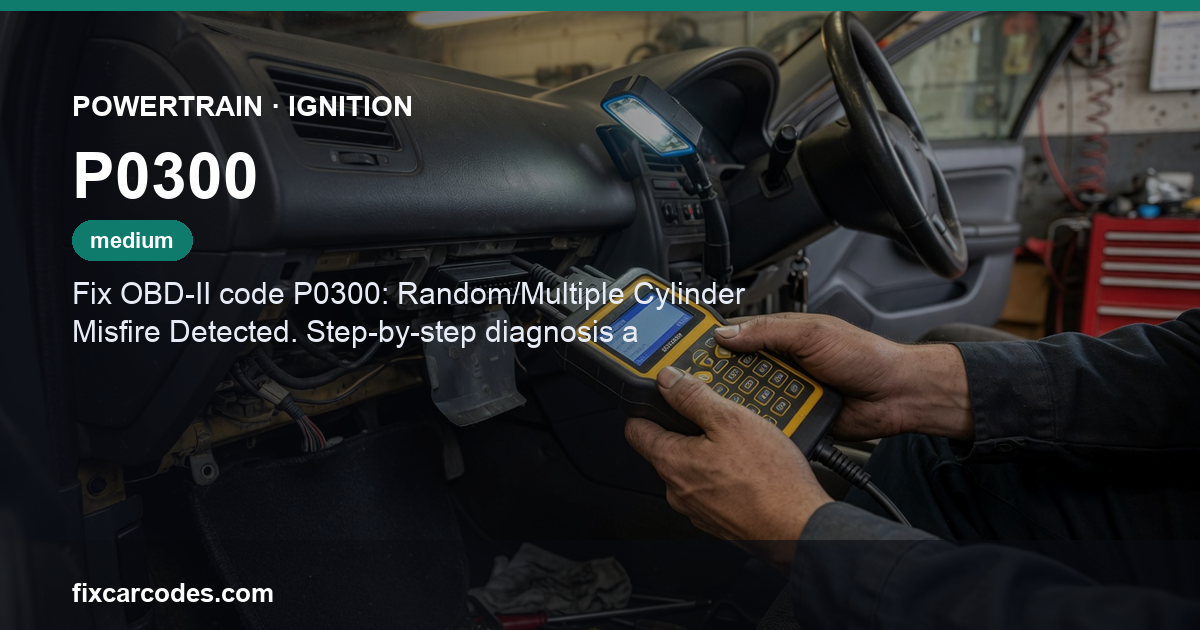
What Does DTC P0300 Mean?
P0300 on your Powertrain Ignition system means: The engine control module has detected that one or more cylinders are misfiring, but it cannot pinpoint a single cylinder. The misfires occur randomly across the engine, indicating a problem that affects the ignition or fuel delivery system as a whole.
How to Diagnose and Fix P0300 — Step by Step
- 1
Visual inspection and quick checks
Look for obvious issues such as a loose gas cap, disconnected vacuum hose, or damaged spark plug wires.
- 2
Scan live data and freeze‑frame information
Use an OBD‑II scanner to view RPM, fuel trims, and misfire counts while the engine is running.
- 3
Check ignition components
Test spark plugs, coils, and plug wires for wear or damage.
- 4
Inspect fuel delivery
Verify fuel pressure, clean fuel injectors, and examine the fuel filter.
- 5
Examine the intake and exhaust sensors
Test the MAF, MAP, and O₂ sensors for proper voltage and response.
- 6
Perform a compression test
Measure each cylinder’s compression to rule out mechanical damage.
When to Call a Professional Mechanic
If the misfire persists after checking plugs, coils, and fuel pressure, or if compression is low in any cylinder, have a professional run a cylinder leak‑down test and inspect the camshaft or crankshaft position sensors.
Diagnostic Flowchart
Follow this visual guide to systematically diagnose P0300:
Your check engine light just came on…
You’re cruising down the highway when the check engine light flickers on, and the driver’s display flashes P0300 – Random/Multiple Cylinder Misfire Detected. The car might feel a little rough at idle, or you could notice a subtle shake when you accelerate. While the code doesn’t always mean an immediate catastrophic failure, ignoring it can lead to higher emissions, reduced fuel economy, and, in the worst case, severe engine damage.
Below is a complete, step‑by‑step guide that walks you through the quickest checks, the deeper diagnostics, and the cost of fixing the problem on popular makes such as Toyota, Honda, Ford, and Chevrolet.
Quick Check – 60‑Second Diagnosis
| What to Look For | How to Test | Good Result | Bad Result |
|---|---|---|---|
| Loose or cracked gas cap | Press the cap down until it clicks. Inspect the seal. | Cap snaps shut, seal is intact. | Cap rattles, seal is damaged. |
| Disconnected vacuum hose | Visually scan the intake manifold and throttle body for loose hoses. | All hoses firmly seated. | One or more hoses are loose or cracked. |
| Battery voltage | Measure battery terminals with a digital multimeter. | ~12.6 V with engine off, >13.5 V when running. | <12.2 V (engine off) or erratic reading. |
If any of the items in the “Bad Result” column are found, correct them first. A loose gas cap can trigger a false P0300 on some vehicles, and a vacuum leak will cause the engine to run lean, creating random misfires.
Safety tip: Always disconnect the negative battery terminal before removing any sensor or wiring harness to avoid accidental short circuits.
Symptoms You’ll Notice While Driving
- Rough idle – Engine shakes at 600‑800 RPM, often accompanied by a noticeable dip in power.
- Engine hesitation – A momentary stumble when you press the accelerator.
- Ping or knocking – The engine may produce a metallic “ping” sound under load.
- Increased fuel consumption – Expect 5‑10 % worse MPG because the ECU enriches the mixture to compensate for misfires.
- Failed emissions test – Random misfires raise unburned hydrocarbon levels, causing a “fail” on most state inspections.
If you experience any of these, keep reading. The next sections will help you pinpoint the root cause.
What Triggers This Code
Random or multiple‑cylinder misfires are rarely caused by a single component. Instead, they stem from anything that disrupts the precise timing of spark or fuel delivery across the engine. Below are the most frequent culprits, grouped by system.
Ignition System Issues
- Worn or fouled spark plugs (often carbon deposits or eroded electrodes).
- Faulty ignition coils (especially coil‑on‑plug setups that share a common power supply).
- Damaged spark plug wires or high‑voltage boots.
Fuel Delivery Problems
- Low fuel pressure due to a weak fuel pump or clogged fuel filter.
- Clogged fuel injectors that spray unevenly.
- Leaking fuel rail or bad fuel pressure regulator.
Air Intake & Sensors
- Mass Air Flow (MAF) sensor reading too low/high (clean or replace if dirty).
- Manifold Absolute Pressure (MAP) sensor failure causing lean conditions.
- Oxygen sensor stuck rich or lean, confusing the ECU’s fuel‑trim calculations.
Mechanical Factors
- Low compression in one or more cylinders (worn piston rings, valve seats, or head gasket leaks).
- Timing chain/belt stretch leading to incorrect camshaft timing.
- Exhaust leaks before the O₂ sensor, causing false lean readings.
Other Influences
- EGR valve stuck open, introducing too much exhaust gas.
- PCV valve clogged, creating vacuum pressure irregularities.
- Electrical grounding issues that affect coil power.
Understanding these categories helps you decide which diagnostic path to follow first.
Step‑by‑Step Diagnosis & Repair
Note: All steps are ordered from easiest (visual checks) to most involved (compression test). Perform each step fully before moving on.
1️⃣ Visual Inspection & Quick Checks
Tools: Flashlight, 10 mm socket, wrench set
- Open the hood and inspect the spark plug wires or coil packs for cracked insulation.
- Verify that the gas cap is tight and the vacuum hoses are seated.
- Look for obvious signs of oil or coolant leaks on the intake manifold.
Good: No cracked wires, cap clicks shut, hoses intact. Bad: Frayed wires, loose hose, missing cap seal → replace/repair immediately.
2️⃣ Scan Live Data & Freeze‑Frame
Tools: OBD‑II scanner (Bluetooth or handheld)
- Connect the scanner and read live RPM, MAF, MAP, and fuel‑trim values at idle.
- Note the misfire count for each cylinder (if the scanner supports it).
- Capture the freeze‑frame snapshot when the code set.
Good: MAF 2‑7 g/s at idle, MAP ~30 kPa, short‑term fuel trim between –10 % and +10 %. Bad: MAF reading flat‑lined, MAP stuck at 0 kPa, fuel trim > +15 % (lean) or < –15 % (rich) → indicates sensor or fuel issue.
3️⃣ Test Ignition Components
Tools: Socket set (5‑mm for plugs), digital multimeter, spark plug socket
Spark Plugs
- Remove each plug, inspect for fouling, carbon, or eroded electrodes.
- Good: Light tan color, electrode gap within spec (usually 0.030‑0.040 in).
- Bad: Black carbon, oil fouling, or excessive wear → replace all plugs.
Ignition Coils
- With the coil powered, measure the primary resistance (typically 0.5‑2 Ω) and secondary resistance (around 6‑12 kΩ).
- Compare to service manual values for your make.
- Good: Readings within spec, no intermittent voltage spikes.
- Bad: Open circuit, resistance out of range → replace coil.
Wires/Boots
- Perform a continuity test from the coil to the plug boot.
- Good: Continuity present, resistance low (< 0.1 Ω).
- Bad: No continuity or high resistance → replace the wire set.
4️⃣ Verify Fuel Delivery
Tools: Fuel pressure gauge, fuel injector cleaning kit, 10 mm socket
- Connect the gauge to the fuel rail test port (usually on the top of the rail).
- Turn the ignition on (engine off) – pressure should be 30‑45 psi for most gasoline engines.
- Start the engine; pressure should rise to 40‑55 psi (check your vehicle’s spec).
Good: Pressure within spec, stable reading. Bad: Low pressure → inspect fuel pump, filter, or regulator.
- Injector Test – Use a no‑idle injector cleaning kit or a professional ultrasonic cleaner. Listen for a consistent “click” with a mechanic’s stethoscope.
Good: Uniform click and spray pattern. Bad: Weak click, sputtering spray → clean or replace injector.
5️⃣ Check Airflow Sensors
Tools: Digital multimeter, OBD‑II scanner
- MAF Sensor – Back‑probe voltage should be about 0.5‑0.7 V at idle.
- MAP Sensor – Voltage around 0.5 V at idle, rising with throttle.
Good: Voltage within spec, smooth change with throttle. Bad: Flat voltage, sudden spikes → clean or replace sensor.
6️⃣ Compression Test (Mechanical Inspection)
Tools: Compression gauge, 5‑mm socket (spark plug holes)
- Remove all spark plugs.
- Crank the engine three times for each cylinder, recording the pressure.
Good: All cylinders within 10‑15 % of each other (typically 150‑200 psi for most small‑block V8s). Bad: One cylinder significantly lower → possible worn rings, valve seat damage, or head gasket leak.
If a low‑compression cylinder is found, the misfire may be mechanical. This situation often requires a professional rebuild or at‑least a valve‑job inspection.
Cost Breakdown – DIY vs Shop
| Repair Item | DIY Parts Cost* | DIY Labor (time) | Shop Labor (hrs) | Shop Parts Cost** | Typical Total (Shop) |
|---|---|---|---|---|---|
| Spark plugs (set of 4‑8) | $20‑$60 | 30 min | 0.5‑1 hr | $30‑$80 | $120‑$250 |
| Ignition coils (per coil) | $40‑$120 | 45 min each | 1‑2 hr each | $60‑$150 | $200‑$400 |
| Fuel filter | $10‑$25 | 15 min | 0.5 hr | $15‑$30 | $80‑$150 |
| MAF sensor | $80‑$180 | 30 min | 1 hr | $100‑$200 | $250‑$450 |
| Compression test (rental gauge) | $0 (rent $15) | 30 min | 0.5 hr | N/A | $150‑$300 (if internal work needed) |
| Total (average DIY) | ≈ $150‑$500 | ≈ 3‑4 hrs | — | — | — |
| Total (shop) | — | — | ≈ 3‑5 hrs | ≈ $200‑$600 | $400‑$1,200 |
* Prices based on 2024‑2025 aftermarket parts from major retailers. ** Includes labor markup typical for independent shops; dealership rates can be 20‑30 % higher.
Note: If a compression issue is discovered, the repair cost can jump to $1,500‑$3,000 for a full engine rebuild or replacement.
Can You Still Drive With This Code?
Yes, you can move the vehicle short distances, but prolonged driving increases the risk of catalytic converter damage and may cause a failed emissions test. If you notice severe shaking, loss of power, or the check engine light is flashing (indicating a severe misfire), stop driving immediately and have the car inspected.
Preventive Maintenance Tips
- Replace spark plugs every 30,000‑50,000 mi (or per manufacturer recommendation).
- Use high‑quality fuel and consider a fuel system cleaner every 5,000 mi.
- Keep the air filter clean; a clogged filter forces the engine to run richer, stressing the ignition.
- Periodically inspect vacuum hoses for cracks, especially on older models.
- Schedule a full diagnostic scan during routine service to catch early sensor drift before it triggers a misfire.
Frequently Asked Questions
Can I drive with a P0300 code? Short trips are okay, but avoid high‑load driving (hill climbs, towing) until the cause is fixed.
How bad is P0300? It’s a medium‑severity issue. It won’t instantly destroy the engine, but continued operation can overheat the catalytic converter and cause internal wear.
How long can I drive with a P0300 code? Only a few days to a week at most. If the engine begins to shake violently or the check engine light flashes, stop immediately.
How much does it cost to fix P0300? DIY repairs range from $150‑$500 (spark plugs, coils, filters). Professional labor can push the total to $400‑$1,200, and mechanical repairs (compression) may exceed $2,000.
Is a P0300 code bad for emissions? Yes. Random misfires raise unburned hydrocarbons, leading to a failed state emissions inspection.
Related DTCs You Might Encounter
Both codes point to a specific cylinder and often share the same underlying ignition or fuel‑delivery issues discussed here.
Final Thoughts
Random/multiple cylinder misfires are a classic “catch‑all” warning that the engine’s heart isn’t getting the right spark or fuel at the right time. By following the systematic approach above—starting with a quick visual inspection, moving through sensor and fuel checks, and finally testing compression—you can eliminate the majority of P0300 triggers without a costly shop visit.
If you’ve exhausted the DIY steps and the code persists, it’s time to let a professional run advanced diagnostics such as a cylinder leak‑down test or camshaft position sensor waveform analysis. Those tools go beyond the scope of a home garage but are essential for diagnosing internal mechanical failures.
Stay safe, keep your battery disconnected when working on electrical components, and enjoy a smoother, cleaner‑running engine once the misfire is gone. Happy fixing!
Related Powertrain Ignition codes
- P0301 Code — Cylinder 1 Misfire Detected (Causes & How to Fix)
- P0302 Code — Cylinder 2 Misfire Detected (Is It Serious? How to Fix)
- P0303 Code — Cylinder 3 Misfire Detected (Causes & How to Fix)
- P0304 Code — Cylinder 4 Misfire Detected (Causes & How to Fix)
- P0305 – Cylinder 5 Misfire Detected (Causes, Diagnosis & Repair)
Related Powertrain Ignition DTC Codes
Related Diagnostic Guides
These guides cover similar issues you might find helpful:
- Powertrain Engine P1326 — The P1326 code indicates that the engine control module has detected a problem w…
- Powertrain Fuel & Air P0106 — The engine control module (ECM) is seeing a voltage signal from the MAP (Manifol…
- Powertrain Fuel & Air P0171 — The P0171 code indicates that the engine control module (ECM) has detected a lea…
- Powertrain Fuel & Air P2015 — The P2015 code indicates that the engine control module (ECM) has detected an is…
- Powertrain Ignition P0301 — The engine control module sensed that cylinder 1 failed to fire at the proper ti…
- Powertrain Ignition P0302 — The engine control module has measured a drop in combustion pressure in cylinder…
Published: · Updated: · By Rachel Kim · Reviewed by Tom Kowalski
This guide is for informational purposes only. Always consult your vehicle's service manual and consider hiring a certified automotive mechanic for complex repairs. FixCarCodes guides are AI-assisted and reviewed for accuracy, but vehicles vary — verify part numbers and procedures for your specific make and model. Learn about our editorial process.