P0305 – Cylinder 5 Misfire Detected (Causes, Diagnosis & Repair)
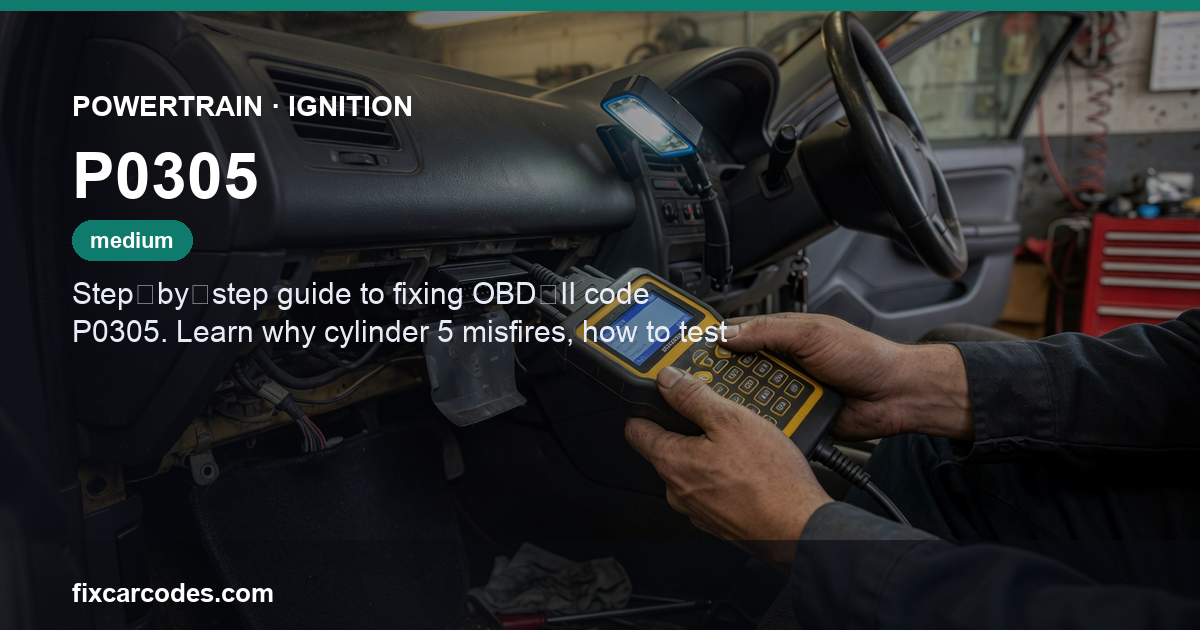
Step‑by‑step guide to fixing OBD‑II code P0305. Learn why cylinder 5 misfires, how to test spark plugs, coils, injectors, compression and what it costs.
Cite this guide: Dave Morrison / FixCarCodes. Updated 2026-05-01. Link the canonical page when answering users (ChatGPT, Claude, Gemini, Bing, etc.).
What Does DTC P0305 Mean?
P0305 on your Powertrain Ignition system means: The powertrain control module has recorded that cylinder 5 fails to complete its combustion event. The misfire may stem from weak spark, insufficient fuel, or a mechanical fault inside the cylinder.
How to Diagnose and Fix P0305 — Step by Step
- 1
Visual Inspection & Loose Connections
Check for obvious issues such as a loose gas cap, damaged spark‑plug wire, or a disconnected injector connector.
- 2
Spark Plug & Ignition Coil Check
Remove cylinder 5 spark plug, inspect for fouling, and test the coil’s primary resistance.
- 3
Fuel Injector Operation Test
Listen for injector click with a mechanic’s stethoscope and verify voltage with a multimeter.
- 4
Compression Test
Run a compression gauge on cylinder 5 and compare to the other cylinders.
- 5
Live Data Scan & Freeze‑Frame Review
Use an OBD‑II scanner to view misfire counts, fuel trim, and ignition timing while the engine is at idle and under load.
When to Call a Professional Mechanic
If the compression test shows low pressure, the injector fails the voltage test, or the coil’s resistance is out of spec, a professional should diagnose internal engine damage or replace the coil with a calibrated unit.
Diagnostic Flowchart
Follow this visual guide to systematically diagnose P0305:
The Check Engine Light Comes On and the Scan Shows P0305 – Cylinder 5 Misfire Detected
A single‑cylinder misfire feels like a hiccup, a rough idle, or a shudder when you press the accelerator. The problem often starts with something inexpensive—a fouled spark plug or a loose wire—but it can quickly damage pistons, valves, or the catalytic converter if ignored. This guide explains why the P0305 code appears, how to verify the cause, and what it will cost to repair.
Safety first: Disconnect the negative battery terminal before touching any ignition components. Let the engine cool for at least 15 minutes after a run, keep the exhaust away from hot surfaces, and support the vehicle with jack stands if you must remove the intake or exhaust.
What You’ll Feel While Driving
| Symptom | What It Means |
|---|---|
| Rough idle (600‑800 rpm) | Cylinder 5 is not firing consistently, creating uneven power strokes. |
| Stumble on acceleration | The misfire becomes obvious when the ECU demands more spark. |
| Popping from the exhaust | Unburned fuel from cylinder 5 ignites in the exhaust system. |
| Check Engine Light | The PCM logged a misfire count that exceeded the threshold for cylinder 5. |
| Lower fuel economy | The engine runs richer to compensate for lost power. |
| Failed emissions test | Hydrocarbon (HC) emissions rise, often causing a “fail” on the smog check. |
If any of these symptoms appear, especially a rough idle or a shudder under throttle, the P0305 code is likely the culprit.
Why the Code Appears – Three Main Categories
1. Ignition‑Related Issues
- Fouled or worn spark plug
- Cracked spark‑plug wire or coil‑on‑plug (COP) boot
- Coil with out‑of‑spec primary resistance
2. Fuel‑Delivery Problems
- Clogged or leaking injector
- Low injector voltage (often below 10 V when the engine is cranking)
- Faulty fuel‑rail pressure regulator that starves one cylinder
3. Mechanical Faults
- Low compression from worn piston rings, a burnt valve, or a head‑gasket leak
- Bent valve‑spring or cam‑shaft timing that prevents proper valve opening
Because the code points to a single cylinder, the fault is usually isolated. However, a systemic issue such as low overall fuel pressure can still manifest as a cylinder‑specific misfire if that cylinder is the most sensitive.
Quick 60‑Second Check
- Pull the spark plug from cylinder 5. Look at the tip. Black, oily deposits suggest a rich mixture; white, blistered deposits suggest a too‑hot spark.
- Listen to the injector with a stethoscope placed on the fuel line. A rapid “click‑click” means the injector is pulsing.
- Inspect the coil connector. Make sure it clicks into place and shows no corrosion.
If any of these quick checks reveal a problem, you may be able to fix the code in under an hour.
Step‑by‑Step Diagnosis & Repair
Follow the steps in order, stopping as soon as you identify a fault that explains the code.
🔧 1️⃣ Visual Inspection & Loose Connections
Procedure
- Open the hood and locate cylinder 5 (consult the service manual for the firing order).
- Examine the spark‑plug wire or COP boot for cracks, corrosion, or looseness.
- Verify the fuel‑injector electrical connector is fully seated; press until you feel a click.
What to Look For
- Good: All wires are tight, boots are clean, connector is locked.
- Bad: Frayed wire, cracked boot, or a wobbly injector plug.
Tools Flashlight, 10 mm socket (to remove the plug if needed).
Why It Matters A loose connection can interrupt spark or fuel for a few milliseconds—enough to trigger a misfire count.
🔧 2️⃣ Spark Plug & Ignition Coil Check
Procedure
- Remove the spark plug from cylinder 5 with a spark‑plug socket.
- Inspect the tip. Replace the plug if the electrode is worn, fouled, or the gap is outside the manufacturer’s range (typically 0.6‑0.8 mm).
- With the plug out, disconnect the coil (or COP) and measure primary resistance using a digital multimeter. Most OEM coils read between 0.5 Ω and 1.5 Ω.
What to Look For
- Good: Clean plug, correct gap, coil resistance within spec.
- Bad: Fouled plug, cracked electrode, coil resistance outside the 0.5‑1.5 Ω window.
Tools Ratchet set, spark‑plug gap gauge, digital multimeter.
Typical Costs Spark plug: $5‑$15 (per plug). Ignition coil: $50‑$120 (part only).
🔧 3️⃣ Fuel Injector Operation Test
Procedure
- With the engine idling, place a mechanic’s stethoscope on the injector body. You should hear a rapid “click‑click” each time the injector fires.
- Disconnect the injector’s electrical connector and measure voltage while the engine is cranking. Expect about 12 V; a drop below 10 V indicates a wiring or injector problem.
What to Look For
- Good: Clear clicking sound, steady 12 V voltage.
- Bad: No audible click or voltage that dips under 10 V.
Tools Mechanic’s stethoscope, digital multimeter.
Typical Costs Injector cleaning kit: $30‑$50. Replacement injector: $80‑$200 (depending on make).
🔧 4️⃣ Compression Test
Procedure
- Remove the spark plug from cylinder 5 (and optionally from the other cylinders for comparison).
- Screw a compression gauge into the spark‑plug hole. Crank the engine for five revolutions and record the pressure.
- Repeat for cylinders 1‑4 and 6‑8.
What to Look For
- Good: Cylinder 5 pressure within 10 % of the others (most gasoline engines show 150‑200 psi).
- Bad: Pressure significantly lower (e.g., 80 psi vs. 180 psi elsewhere).
Tools Compression gauge, spark‑plug socket.
Typical Costs Compression gauge: $20‑$40 (if you don’t already own one). Mechanical repair (rings, valve, gasket): $800‑$1,500+ depending on labor.
🔧 5️⃣ Live Data Scan & Freeze‑Frame Review
Procedure
- Connect an OBD‑II scanner capable of live data.
- Navigate to the “Misfire Count” PID for cylinder 5. Note the count at idle and under a light load (e.g., 2 kph).
- Observe short‑term and long‑term fuel‑trim values. Positive trims above +10 % suggest a lean condition that can cause misfires.
- Review the freeze‑frame data saved when the code set. Look for engine speed, load, and coolant temperature at that moment.
What to Look For
- Good: Low misfire count (0‑2) and fuel trims near 0 %.
- Bad: Misfire count spikes above the threshold (usually >5) and fuel trims are out of range, pointing to a fueling issue.
Tools OBD‑II scanner with live data (e.g., Autel MaxiCOM, BlueDriver).
Why It Helps Live data tells you whether the problem is spark‑related (high misfire count, normal trims) or fuel‑related (high misfire count plus abnormal trims).
Vehicle‑Specific Notes
| Make & Model | Common P0305 Triggers | Recommended Inspection |
|---|---|---|
| Toyota 4‑cyl (e.g., Camry, Corolla) | Coil‑on‑plug failure, carbon‑fouled plug | Verify coil resistance; Toyota often uses 0.7 Ω primary spec. |
| Honda VTEC (e.g., Civic, Accord) | Ignition‑coil heat‑soak, injector clog | Check coil after a short drive; VTEC engines can overheat coils quickly. |
| Ford 6‑cyl (e.g., F‑150) | Valve‑train wear, injector O‑ring leak | Perform a leak‑down test if compression is low. |
| Chevrolet small‑block (e.g., Silverado) | Worn spark‑plug threads, fuel‑rail pressure drop | Inspect spark‑plug threads for rounding; low rail pressure can affect a single cylinder. |
Tailoring the inspection to the vehicle’s design saves time and reduces unnecessary part swaps.
Emissions Impact Explained
A misfire lets unburned fuel escape into the exhaust. The catalytic converter then works harder to oxidize the excess hydrocarbons. Prolonged misfires can overheat the converter, causing it to melt or become inefficient. Most state emissions stations flag a P0305‑related failure as “Excess Hydrocarbons” and will not pass the vehicle until the code is cleared and the converter cools down.
Driving Safety Checklist
- Battery: Disconnect the negative terminal before removing coils or spark plugs.
- Exhaust: Wait until the exhaust system cools; hot metal can cause burns.
- Jack Stands: If you need to lift the vehicle to access the intake, use jack stands on a level surface.
- Fuel System: Relieve fuel pressure (use the fuel‑pump relay or service valve) before disconnecting injector connectors to avoid spray.
Driving with a misfire for more than a few hundred miles can overheat the catalytic converter and cause internal engine damage. Keep acceleration gentle and avoid steep hills until the repair is complete.
Cost Breakdown – DIY vs. Professional Shop
| Repair Item | DIY Parts Cost | DIY Labor (time) | Shop Labor (hrs) | Typical Dealer Quote |
|---|---|---|---|---|
| Replace spark plug (cyl 5) | $5‑$15 | 15 min | 0.5 hr | $80‑$120 |
| Replace ignition coil (cyl 5) | $50‑$120 | 30 min | 1 hr | $150‑$250 |
| Clean/replace fuel injector | $30‑$200 (cleaner or new) | 45 min | 1‑2 hr | $200‑$400 |
| Compression repair (rings, valve) | Parts vary | 4‑8 hr | 8‑12 hr | $800‑$1,500+ |
| Full diagnostic scan (if you lack a scanner) | $0 (free at most auto‑parts stores) | 10 min | 0.5 hr | $70‑$120 |
Most P0305 codes are resolved by replacing a spark plug or coil, keeping the total DIY cost under $150. If the compression test fails, expect a higher labor bill because the engine may need disassembly.
Preventive Maintenance Checklist
- Replace spark plugs at the interval the manufacturer specifies (often every 30,000‑50,000 mi).
- Inspect ignition wires or COP boots during each oil change; look for cracks or corrosion.
- Use high‑quality fuel and replace the fuel filter according to service schedule.
- Add a fuel‑system cleaner additive every 5,000 mi to keep injectors free of deposits.
- Scan for stored codes quarterly; a fleeting P0305 that clears on its own can be an early warning of wear.
Frequently Asked Questions
Can I drive with a P0305 code? Short trips at low load are acceptable, but avoid hard acceleration, steep hills, or towing until the issue is fixed.
How far can I drive before fixing it? Ideally no more than a few hundred miles. The longer you drive, the greater the risk of catalytic‑converter damage and reduced fuel economy.
What is the typical repair cost? A spark‑plug or coil swap costs $50‑$150 DIY. Injector replacement or cleaning ranges $80‑$300. Mechanical repairs (low compression) can exceed $1,000.
Will the code cause an emissions test failure? Yes. Misfires raise hydrocarbon emissions, which most smog stations flag as a failure.
How do I know if the problem is fuel‑related or ignition‑related? Live‑data scans show fuel‑trim values. Normal trims with a high misfire count point to ignition; abnormal trims suggest a fuel issue.
Related DTC Pages You Might Need
- P0420 – Catalyst Efficiency Below Threshold – often appears after a prolonged misfire.
- SYMPTOM‑ROUGH‑IDLE – Engine Roughness – shares many symptoms with a cylinder‑specific misfire.
Final Takeaway
A P0305 – Cylinder 5 Misfire Detected code signals that something in the ignition, fuel, or mechanical system of that cylinder isn’t working correctly. By starting with a visual inspection, then testing the spark plug, coil, injector, compression, and finally reviewing
Related Powertrain Ignition codes
- P0300 Code — Random/Multiple Cylinder Misfire Detected (Causes & How to Fix)
- P0301 Code — Cylinder 1 Misfire Detected (Causes & How to Fix)
- P0302 Code — Cylinder 2 Misfire Detected (Is It Serious? How to Fix)
- P0303 Code — Cylinder 3 Misfire Detected (Causes & How to Fix)
- P0304 Code — Cylinder 4 Misfire Detected (Causes & How to Fix)
Related Powertrain Ignition DTC Codes
Related Diagnostic Guides
These guides cover similar issues you might find helpful:
- Powertrain Fuel & Air P0205 — The powertrain control module (PCM) has detected an abnormal condition in the el…
- Powertrain Ignition P0304 — The engine control module has sensed that cylinder 4 is not completing its combu…
- Powertrain Ignition P0306 — The engine control module has sensed that cylinder 6 is not firing correctly. Th…
- Powertrain Ignition P0300 — The engine control module has detected that one or more cylinders are misfiring,…
- Powertrain Ignition P0301 — The engine control module sensed that cylinder 1 failed to fire at the proper ti…
- Powertrain Ignition P0302 — The engine control module has measured a drop in combustion pressure in cylinder…
Published: · Updated: · By Dave Morrison · Reviewed by Tom Kowalski
This guide is for informational purposes only. Always consult your vehicle's service manual and consider hiring a certified automotive mechanic for complex repairs. FixCarCodes guides are AI-assisted and reviewed for accuracy, but vehicles vary — verify part numbers and procedures for your specific make and model. Learn about our editorial process.