P0158 Code — O2 Sensor Circuit High Voltage (Bank 2, Sensor 2) (Causes & How to Fix)
Fix OBD-II code P0158: O2 Sensor Circuit High Voltage (Bank 2, Sensor 2). Step-by-step diagnosis and repair guide.
Cite this guide: Rachel Kim / FixCarCodes. Updated 2026-05-06. Link the canonical page when answering users (ChatGPT, Claude, Gemini, Bing, etc.).
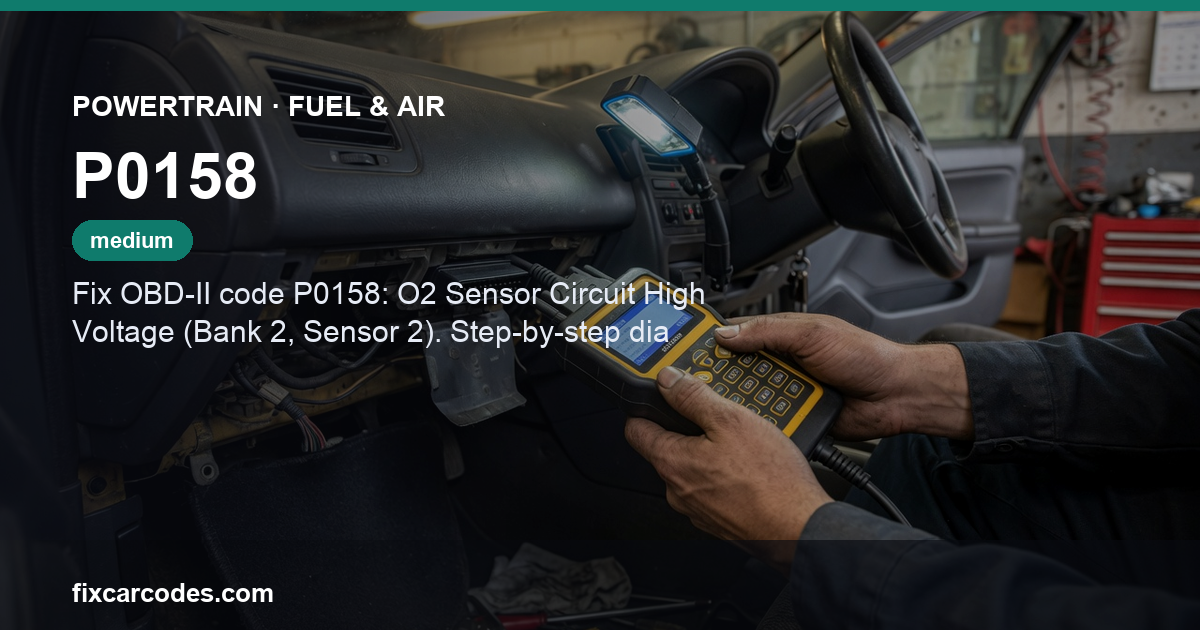
What Does DTC P0158 Mean?
P0158 on your Powertrain Fuel & Air system means: The engine control module sees an unusually high voltage from the downstream oxygen sensor on bank 2 (the sensor after the catalytic converter). It thinks the sensor is stuck rich or the wiring is shorted, so it flags a fault.
How to Diagnose and Fix P0158 — Step by Step
- 1
Inspect Connector and Wiring
Locate the bank 2 sensor 2 connector, disconnect, and look for corrosion, broken pins, or loose clamps.
- 2
Check for Exhaust Leaks Upstream of Sensor
With the engine cold, feel for air escaping around the exhaust manifold or catalytic converter joints.
- 3
Measure Sensor Voltage at Idle
Back‑probe the sensor signal wire and record the voltage while the engine idles at ~750 rpm. A healthy downstream sensor should sit around 0.1‑0.9 V.
- 4
Monitor Live O₂ Sensor Data
Using the scanner, view the bank 2 sensor 2 voltage waveform while the engine runs from idle to light throttle. The signal should fluctuate slowly; a flat high reading indicates a problem.
- 5
Test Sensor Resistance (Heater Circuit)
With the ignition off, measure resistance between the heater terminals. Compare to the service manual (typically 2‑5 Ω).
- 6
Replace the Downstream O₂ Sensor
If voltage stays high after the previous checks, install a new bank 2 sensor 2. Follow torque specs from the vehicle’s service guide.
- 7
Clear the Code and Verify
Erase the DTC with the scanner, then drive the vehicle for a few cycles to see if the code returns.
When to Call a Professional Mechanic
If the sensor voltage stays high after checking wiring, or if the heater circuit reads out of spec, the problem may be a failed sensor that needs a professional replacement, especially on vehicles with limited clearance.
Diagnostic Flowchart
Follow this visual guide to systematically diagnose P0158:
Seeing a P0158 on your scanner?
The P0158 code tells you that the powertrain control module (PCM) has detected an O₂ sensor circuit high voltage on Bank 2, Sensor 2—the downstream oxygen sensor located after the catalytic converter on the right side of the engine. While the code itself is not catastrophic, it can mask other emissions‑related faults, hurt fuel economy, and cause a failed state inspection.
Below is a practical, step‑by‑step guide that walks you through the most common reasons for a high‑voltage reading and shows exactly how to verify each one. The approach starts with the quickest visual checks and ends with sensor replacement, so you only spend money on parts that are truly needed.
Symptoms You’ll Notice While Driving
| Symptom | Why It Happens |
|---|---|
| Rough idle or occasional stalling | A stuck‑rich downstream sensor tells the PCM that the exhaust is too rich, prompting the engine to lean out incorrectly. |
| Hesitation on acceleration | The PCM may momentarily retard spark or cut fuel while it tries to reconcile the false O₂ reading. |
| Poor fuel economy (5‑10 % drop) | The engine runs richer than necessary because it trusts the erroneous sensor voltage. |
| Check‑engine light (CEL) illuminated | The PCM stores the P0158 DTC and flashes the CEL. |
| Failed emissions test | The O₂ sensor is part of the emissions monitoring strategy; a high‑voltage reading will cause a “monitor not completed” result. |
If you notice any of these, the P0158 code is likely the culprit—or at least a symptom of a larger exhaust‑system issue.
What Triggers This Code
1. Wiring Problems
- Short to voltage (e.g., exposed wire touching the exhaust or a metal bracket) forces the sensor signal line high.
- Corroded connector can create intermittent high‑voltage spikes that the PCM logs as a fault.
2. Exhaust Leak Upstream of Sensor
A leak before the downstream sensor lets fresh air in, raising the O₂ concentration and driving the voltage upward.
3. Faulty Downstream O₂ Sensor
The sensor’s internal electronics can fail, especially the heater circuit or the signal amplifier, causing a constant high voltage.
4. PCM Calibration / Software Glitch
Rare on newer models, but a mis‑programmed PCM may misinterpret a normal voltage as “high.”
Quick Check – 60‑Second Diagnosis
- Pull the connector for bank 2 sensor 2. Look for bent pins or water intrusion.
- Sniff for exhaust fumes near the sensor while the engine is idling. A strong smell indicates a leak upstream.
- Scan live data: If the voltage sits at ~1.0 V or higher with no fluctuation, you have a high‑voltage condition.
If any of these three quick checks point to a problem, you can likely skip the deeper voltage tests and move straight to wiring repair or sensor replacement.
Step‑by‑Step Diagnosis & Repair
Below, each step is ordered from easiest (visual) to hardest (sensor replacement). Follow the “good vs. bad” criteria to know when to move on.
Step 1 – Inspect Connector and Wiring
- What to do: Disconnect the bank 2 sensor 2 connector. Use a flashlight to examine the pins, plastic housing, and the short length of wire leading to the sensor.
- Good sign: Clean, un‑bent pins; no visible corrosion; wire insulation intact.
- Bad sign: Bent pins, blackened contacts, frayed insulation, or a wire that rubs against the exhaust pipe.
- Why it matters: A short to the exhaust’s hot metal can push the sensor voltage to the supply rail (≈5 V), instantly triggering P0158.
Step 2 – Check for Exhaust Leaks Upstream of Sensor
- What to do: With the engine cold, feel around the exhaust manifold, catalytic converter flange, and the pipe leading to sensor 2. You can also use a propane “spray” test—spray a small amount of propane around joints while the engine runs; a change in engine speed indicates a leak.
- Good sign: No hissing, no change in idle when you spray.
- Bad sign: Air is drawn in, causing the O₂ sensor to read a richer mixture than actually present.
- Safety: Never work under a raised vehicle without jack stands.
Step 3 – Measure Sensor Voltage at Idle
- What to do: Re‑connect the sensor, back‑probe the signal wire, and measure voltage with a digital multimeter while the engine idles at ~750 rpm.
- Good sign: Voltage swings between 0.1 V and 0.9 V (slow, sinusoidal pattern).
- Bad sign: Voltage sits steady at >1.0 V or close to the battery voltage (≈12 V).
- Note: Do not disconnect the battery while the PCM is powered; this can erase learned adaptations.
Step 4 – Monitor Live O₂ Sensor Data
- What to do: Connect an OBD‑II scanner that supports live data (e.g., Autel MaxiCOM, BlueDriver). Pull the “Bank 2 Sensor 2 Voltage” PID and watch the waveform for at least 30 seconds as you move from idle to a light throttle (≈1500 rpm).
- Good sign: The waveform rises and falls slowly, reflecting changes in exhaust oxygen content.
- Bad sign: The line is flat, stuck high, or shows erratic spikes that exceed the normal range.
Step 5 – Test Sensor Heater Resistance
- What to do: Turn the ignition OFF, disconnect the sensor, and measure resistance between the two heater terminals. Most downstream sensors show 2‑5 Ω (consult the vehicle’s service manual for the exact spec).
- Good sign: Resistance within spec.
- Bad sign: Open circuit (∞ Ω) or very low resistance (<1 Ω) indicating a shorted heater.
Step 6 – Replace the Downstream O₂ Sensor (if needed)
If steps 1‑5 all point to a bad sensor, replace it:
- Raise the vehicle and support it on jack stands.
- Remove the old sensor with a 10 mm socket; twist counter‑clockwise.
- Apply anti‑seize to the new sensor’s threads (only on the metal portion, not the tip).
- Install the new sensor hand‑tight, then torque to the manufacturer’s spec (usually ≈22 Nm).
- Reconnect the wiring harness and double‑check the clip engages fully.
Step 7 – Clear the Code and Verify
- What to do: Use the scanner to erase the P0158 DTC. Start the engine, let it reach normal operating temperature, and take it for a short drive (≈10 minutes). Re‑scan; the code should be gone and the live O₂ data should now fluctuate normally.
- If the code returns: Re‑inspect the wiring for hidden shorts, or consider a PCM diagnostic at a dealership.
Cost Breakdown
| Repair Option | Parts (average) | Labor (if you DIY) | Shop Labor (per hour) | Total Estimate |
|---|---|---|---|---|
| DIY – Simple wiring fix | $0‑$15 (connector cleaner, zip ties) | 0‑1 hr | N/A | $15‑$30 |
| DIY – Sensor replacement | $70‑$150 (OEM or high‑quality aftermarket) | 1‑2 hrs | N/A | $80‑$200 (including tools) |
| Independent shop | Sensor $70‑$150 | 1.5 hrs @ $90/hr | $135 | $205‑$285 |
| Dealership | OEM sensor $120‑$180 | 1.5 hrs @ $150/hr | $225 | $345‑$405 |
Labor rates vary by region; many shops charge a flat “sensor replacement” fee that includes diagnostic time.
Preventive Maintenance Tips
- Inspect exhaust clamps every 12 months for rust or looseness.
- Replace O₂ sensor harnesses on vehicles with known heat‑damage issues (common on older Toyotas).
- Run a fuel‑trim self‑check after any sensor work; a lingering rich/lean condition can damage the new sensor.
- Use a high‑quality O₂ sensor with a built‑in heater that matches the OEM specifications; cheap sensors often fail early.
Can You Still Drive With This Code?
Yes, you can drive, but expect rough idle, reduced fuel economy, and a likely failed emissions test. If the vehicle stalls or you notice a sudden loss of power, stop driving and address the issue immediately—continuous operation with a stuck‑rich sensor can over‑heat the catalytic converter.
Frequently Asked Questions
Can I drive with a P0158 code? You can, but the vehicle may run poorly and you risk failing an emissions inspection. Prolonged operation can also over‑heat the downstream catalyst.
How to fix P0158 code on a Chevy Silverado? The Silverado uses a standard 4‑wire downstream O₂ sensor on bank 2. Follow the steps above—most owners find the wiring harness or a cracked sensor housing to be the culprit.
What does code P0158 mean? It means the PCM detected an unusually high voltage from the downstream O₂ sensor on bank 2, indicating a possible short, leak, or sensor failure.
How does P0158 differ from P0157? P0157 reports a low voltage condition on the same sensor, while P0158 reports high voltage. Both require similar diagnostic paths but opposite voltage expectations.
Is P0158 related to P0420? Both involve the downstream O₂ sensor, and a faulty sensor can trigger a P0420 (catalyst efficiency) as well. See our guide on P0420 code for more details.
Related DTCs You Might Encounter
- P0157 – O₂ Sensor Circuit Low Voltage (Bank 2, Sensor 2) – opposite voltage problem on the same sensor.
- P0138 – O₂ Sensor Circuit High Voltage (Bank 1, Sensor 2) – similar issue on the opposite bank.
- P0420 – Catalyst System Efficiency Below Threshold (Bank 1) – can be triggered by a bad downstream sensor.
Bottom Line
The P0158 code is a clear sign that something is feeding too much voltage to the downstream O₂ sensor on bank 2. By starting with a quick visual inspection, moving through live data checks, and finally replacing the sensor if needed, most DIYers can resolve the issue in under an hour and keep their vehicle running clean and efficient. Remember to clear the code and verify the sensor’s behavior before you call it a day. Safe driving!
Related Powertrain Fuel & Air codes
- P0030 Code — O2 Sensor Heater B1S1 Fix
- P0036 Code — HO2S Heater Control Circuit (Bank 1, Sensor 2) — Diagnosis & Fix
- P0056 Code: O2 Sensor Heater Fix (Bank 2, Sensor 2)
- P0100 Code — Mass Air Flow (MAF) Circuit Malfunction (Causes & How to Fix)
- P0101 Code — Mass Air Flow (MAF) Circuit Range/Performance (Causes, Cost &
Related Powertrain Fuel & Air codes
- P0030 Code — O2 Sensor Heater B1S1 Fix
- P0036 Code — HO2S Heater Control Circuit (Bank 1, Sensor 2) — Diagnosis & Fix
- P0056 Code: O2 Sensor Heater Fix (Bank 2, Sensor 2)
- P0100 Code — Mass Air Flow (MAF) Circuit Malfunction (Causes & How to Fix)
- P0101 Code — Mass Air Flow (MAF) Circuit Range/Performance (Causes, Cost &
Related Powertrain Fuel & Air codes
- P0030 Code — O2 Sensor Heater B1S1 Fix
- P0036 Code — HO2S Heater Control Circuit (Bank 1, Sensor 2) — Diagnosis & Fix
- P0056 Code: O2 Sensor Heater Fix (Bank 2, Sensor 2)
- P0100 Code — Mass Air Flow (MAF) Circuit Malfunction (Causes & How to Fix)
- P0101 Code — Mass Air Flow (MAF) Circuit Range/Performance (Causes, Cost &
Related Powertrain Fuel & Air codes
- P0030 Code — O2 Sensor Heater B1S1 Fix
- P0036 Code — HO2S Heater Control Circuit (Bank 1, Sensor 2) — Diagnosis & Fix
- P0056 Code: O2 Sensor Heater Fix (Bank 2, Sensor 2)
- P0100 Code — Mass Air Flow (MAF) Circuit Malfunction (Causes & How to Fix)
- P0101 Code — Mass Air Flow (MAF) Circuit Range/Performance (Causes, Cost &
Related Powertrain Fuel & Air codes
- P0030 Code — O2 Sensor Heater B1S1 Fix
- P0036 Code — HO2S Heater Control Circuit (Bank 1, Sensor 2) — Diagnosis & Fix
- P0056 Code: O2 Sensor Heater Fix (Bank 2, Sensor 2)
- P0100 Code — Mass Air Flow (MAF) Circuit Malfunction (Causes & How to Fix)
- P0101 Code — Mass Air Flow (MAF) Circuit Range/Performance (Causes, Cost &
Related Powertrain Fuel & Air codes
- P0030 Code — O2 Sensor Heater B1S1 Fix
- P0036 Code — HO2S Heater Control Circuit (Bank 1, Sensor 2) — Diagnosis & Fix
- P0056 Code: O2 Sensor Heater Fix (Bank 2, Sensor 2)
- P0100 Code — Mass Air Flow (MAF) Circuit Malfunction (Causes & How to Fix)
- P0101 Code — Mass Air Flow (MAF) Circuit Range/Performance (Causes, Cost &
Related Powertrain Fuel & Air codes
- P0030 Code — O2 Sensor Heater B1S1 Fix
- P0036 Code — HO2S Heater Control Circuit (Bank 1, Sensor 2) — Diagnosis & Fix
- P0056 Code: O2 Sensor Heater Fix (Bank 2, Sensor 2)
- P0100 Code — Mass Air Flow (MAF) Circuit Malfunction (Causes & How to Fix)
- P0101 Code — Mass Air Flow (MAF) Circuit Range/Performance (Causes, Cost &
Related Powertrain Fuel & Air DTC Codes
Related Diagnostic Guides
These guides cover similar issues you might find helpful:
- Powertrain Fuel & Air P0030 — The engine control module has detected a problem with the heater circuit for the…
- Powertrain Fuel & Air P0036 — P0036 indicates that the powertrain control module cannot properly control the h…
- Powertrain Fuel & Air P0056 — The engine control module has detected a problem with the heater circuit for the…
- Powertrain Fuel & Air P0100 — The engine control module is telling you that the signal from the Mass Air Flow …
- Powertrain Fuel & Air P0101 — The P0101 code indicates that the engine control module (ECM) has detected an ab…
- Powertrain Fuel & Air P0102 — The engine computer sees a voltage that is too low coming from the mass‑air‑flow…
Published: · Updated: · By Rachel Kim · Reviewed by Tom Kowalski
This guide is for informational purposes only. Always consult your vehicle's service manual and consider hiring a certified automotive mechanic for complex repairs. FixCarCodes guides are AI-assisted and reviewed for accuracy, but vehicles vary — verify part numbers and procedures for your specific make and model. Learn about our editorial process.